Handy sensor enhances food safety
Eva Choy
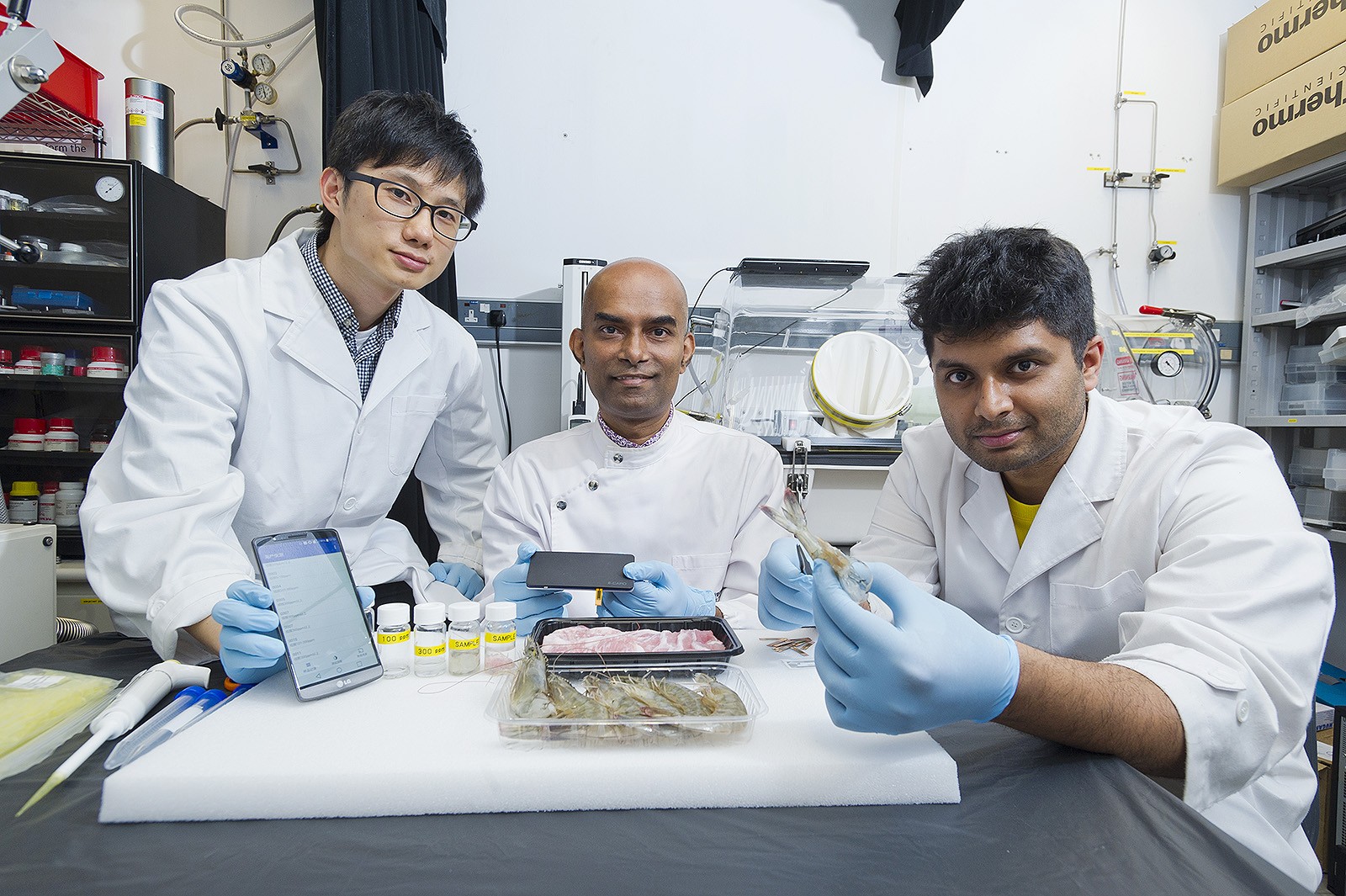
A new system for testing food safety developed by an interdisciplinary research team at City University of Hong Kong (CityU) can rapidly detect contaminants in food within several minutes with concentrations of less than 0.2ppm (parts per million).
The new sensor, which can be operated via mobile phone apps, offers rapid and accurate measurements of harmful elements that might be present in some food items such as seafood and meat. With a prototype already in operation, the cost of detecting contaminants is expected to fall.
“We expect the system to be used by the public and private sectors. It can help government departments to monitor food quality and assist supermarkets in testing food on spot,” said Dr Roy Vellaisamy, Associate Professor in the Department of Materials Science and Engineering (MSE), who is leading the project.
The project, titled “Rapid test technology and commercialisation of nano-sensor for detection of chemical contaminants in seafood”, has already attracted a great deal of commercial interest.
It was selected as “Demonstrative Project of Innovative Development for Marine Economy under the National 13th Five-Year Plan” and received a grant worth RMB20 million from the Ministry of Finance, State Oceanic Administration and Xiamen Innov Electronics Tech Co., Ltd. (Xminnov).
The sensor has been designed to detect histamine and formaldehyde, contaminants commonly found in seafood and meat. The existence of histamine indicates food decay because it is generated when bacteria grows in food. Formaldehyde is an illegal additive used in seafood, and is hazardous to human health.

The sensor makes food testing convenient because conventional tests for histamine and formaldehyde take about one day in a laboratory. But the handy CityU sensor can prescreen the food samples on the spot using a mobile phone and identify the presence of histamine and formaldehyde in 10 to 25 minutes.
“Each contaminant (analyte) has a specific bonding nature to a particular receptor. By using a chip that contains a specific receptor, the new sensor can indicate the existence and concentration of the target contaminant,” Dr Vellaisamy explained.
CityU’s sensor can detect up to 100 ppm for histamine, and for formaldehyde it can be 0.2ppm. This level of detection complies with the standard set by international monitoring bodies such as the World Health Organization and the U.S. Food and Drug Administration.
This project also makes use of the technology of Internet of Things (IoT) such as RFID labels to store the data of random food tests on the cloud for tracking and management purposes.
The project is a collaborative effort between CityU, Xminnov, the Fisheries College of Jimei University and the Inspection and Quarantine Technology Center of China Customs (Xiamen) Entry-Exit Inspection and Quarantine Bureau. The background research work was funded by the Innovation and Technology Fund of the Hong Kong SAR Government.
The other members of the CityU’s research team are Professor Michael Lam Hon-wah from the Department of Chemistry, Senior Research Associate Mr Yeung Chi-chung, and MSE PhD student Shishir Venkatesh.