


From Computational Social Science to Social Impact
Concerns about AI are rife but it pays to recall earlier responses to social media—learning how to make the most effective use of it will ultimately be to our great advantage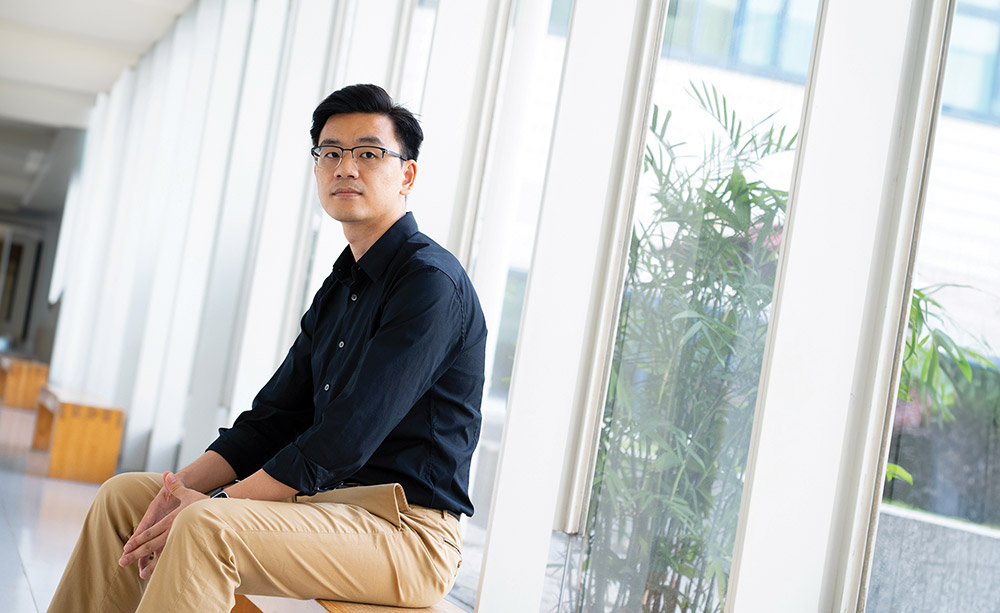
Seeing his research have a social impact is one of the most rewarding aspects of work for Wang.

Wang believes that society needs to embrace advances in technology such as AI rather than to fear it.
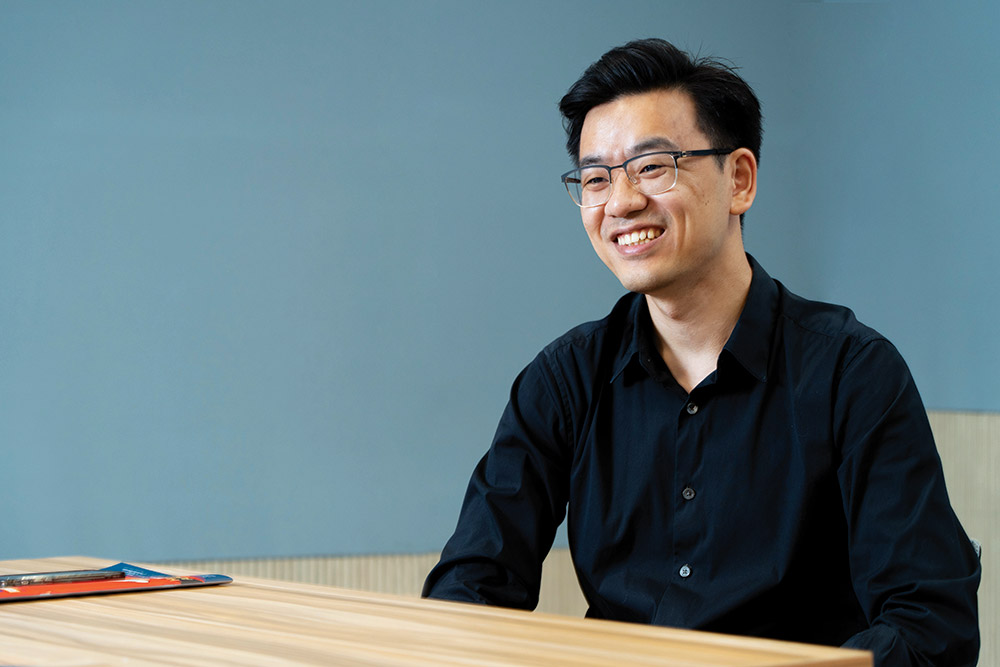
Instead of banning AI technology, Wang thinks that it is more important to foster algorithm literacy among students.
In today’s digital age, the spread of information and its impact on society cannot be understated. During the years of COVID-19, information played a powerful role in determining—for better and for worse—how the pandemic panned out in communities across the world and affected billions of lives.
This is one of the many reasons why Professor Vincent WANG Xiaohui’s work is so important in understanding the world we live in today. As an Assistant Professor in the Department of Media and Communication at CityU’s College of Liberal Arts and Social Sciences, Wang’s research looks at the convergence and intersection of information, communication and new technologies, with a particular focus on social media, computational social science, health information and human-computer interaction.
“Computational social science is an interdisciplinary field that leverages the power of computational methods and social science theory to address social issues,” he explains. Using digital trace data such as social media data, online forum data and similar sorts of platforms, Wang’s research seeks to understand the basis of human interaction through technology.
“On a large enough scale, real data from social media can help us to understand human activities at a societal level,” he says.
Wang’s passion can be traced back to the years when he was completing his PhD in Information Studies at Nanyang Technological University. During that time, he met two professors working in computational social science whose work and mentorship inspired him to pursue his own research in the field.
Another reason for following this area of study is that he enjoys the interdisciplinary nature of computational social science.
“One reason I chose to study computational social science is that I had positioned myself to be an interdisciplinary scholar,” he explains. “My research focus was on bridging the gap between different disciplines.”
Putting Theory into Practice
In fact, Wang is a leader in this field, being a member of the Web Mining Lab at CityU and a scientist at the Laboratory for AI-Powered Financial Technologies Limited, a research and technology centre co-founded by CityU and the Ivy League Columbia University.
Above all else, what drives Wang is a passion for seeing his research used in real-life situations and how it can make a real social impact. As an example, in 2018, Wang was part of a study that looked at misinformation on social media platforms. His research was later turned into a policy document for the World Health Organization.
“I felt really excited by this,” he says, “and this is something that motivates me to do more research that can have real social impact.”
Wang works in a field that is quickly changing thanks to the constant development of new technologies. One established new arena is social media, which has played an increasingly powerful role in society since the onset of Facebook almost two decades ago.
“In the beginning, people tried to discuss whether we needed to adopt social media. Of course, we don’t discuss this anymore,” Wang says. “But after 20 years of research, what are some conclusions we have reached about social media?”
According to Wang, the consensus today is that social media cannot be categorised into “the good, the bad or the ugly”, but instead needs to be understood as a complex social system. On the positive side, it can provide support and encourage engagement through online communities. On the flip side, it can lead to the fragmentation of society, polarisation, and the viral spread of misinformation and hate speech.
“Social media is more like an extension of yourself and a mirror of the faces of society, so it’s become part of the social system.”
AI and Moving Beyond Social Media
However, Wang believes that Mark ZUCKERBERG’s creation may have passed the peak of its influence. Now, the focus is on AI.
“People are paying less attention to social media. Instead, they are talking more about ChatGPT and how AI chatbots are reshaping society and communications,” Wang says.
While he sees some similarities between AI and social media, Wang says that there are differences in the way people consume and spread information, and how research is conducted using AI.
Wang notes that AI’s impact is already wide-reaching—not only in communication practice, but also in news, business and even education.
Social media cannot simply be categorised into “the good, the bad, or the ugly”, but instead needs to be understood as part of the complex social system
Professor Vincent Wang Xiaohui
The professor admits that AI is a minefield and that the rise of chatbots has created the opportunity for plagiarism as well as many questions surrounding the originality of content. But his advice is that instead of looking away or banning the technology, society needs to learn to embrace it and use it to its advantage.
With his own students, Wang has found ways to harness the technology in the classroom.
“We try to train students to have the ability to ask questions of AI as well as the ability to judge the quality of the answers provided by ChatGPT because its online resources and information come from different databases online,” he explains.
There is no overseeing function that governs the content AI uses, and the information in its database can be of varied quality. The information used can even be entirely fabricated, but Wang believes that students need to develop an ability to discern what is and isn’t credible information.
Furthermore, he believes that students today must have some level of algorithm literacy, meaning the ability to judge the quality of AI answers and how far they should incorporate this new technology into their own work.
“We are not talking about ChatGPT as a research objective,” Wang declares. “We are actually talking about how to incorporate it into the whole research process, for brainstorming, data collection, and data analysis.”
Looking to the Future
When thinking ahead, Wang believes that AI will remain the focus of attention, as AI-assisted communication and human-AI interaction will take centre stage in shaping communication.
The challenge in the short term will continue to be the spread of misinformation. Much like in the social media age, Wang reckons that AI-generated content will remain an issue since it remains difficult for algorithms to detect whether the content was generated by a bot or not.
“Misinformation still exists in the areas of ChatGPT and so, again, it puts the onus back on the user to cross-check and judge whether the information is true or false,” he says. “In the end, humans are still very important.”
For now, Wang has his work cut out for him as his research is also looking at digital divides in society, the new gaps in the society introduced by the advance of algorithms and big data, the benefit of communication technologies for mental health, and reflecting on the evolution of technology and how it will shape the way humans interact with one another.
Still, seeing his research make a meaningful impact keeps Wang motivated. “I really enjoy this practical aspect of my research,” he says, Wang believes that society needs to embrace advances in technology such as AI rather than to fear it. “it’s not just relevant in my classroom but to the whole of society.”