


City Literature: Thoughts and Ideas about Hong Kong
Educators are determined to promote city literature, a genre of literature which depicts the culture, people, and happenings of where we live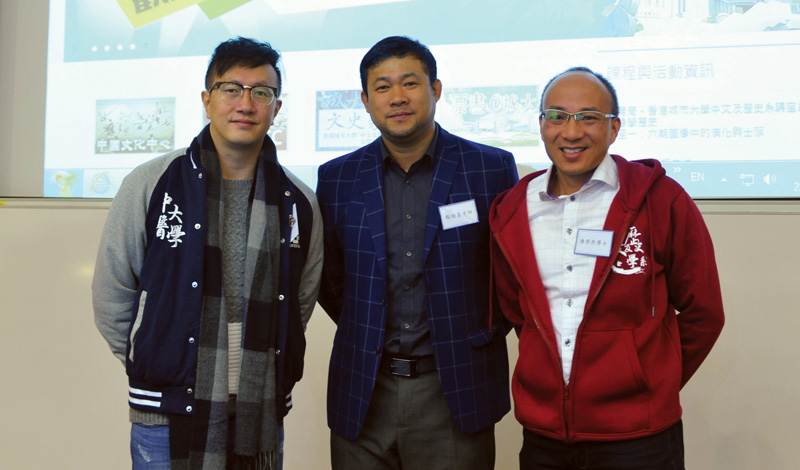
(From right) Dr Chan Hok-yin, and local writers and secondary school teachers Yan Pui-kei and Chan Chi-kian, are nurturing students’ interest in literature and writing by organising workshops, seminars and competitions.
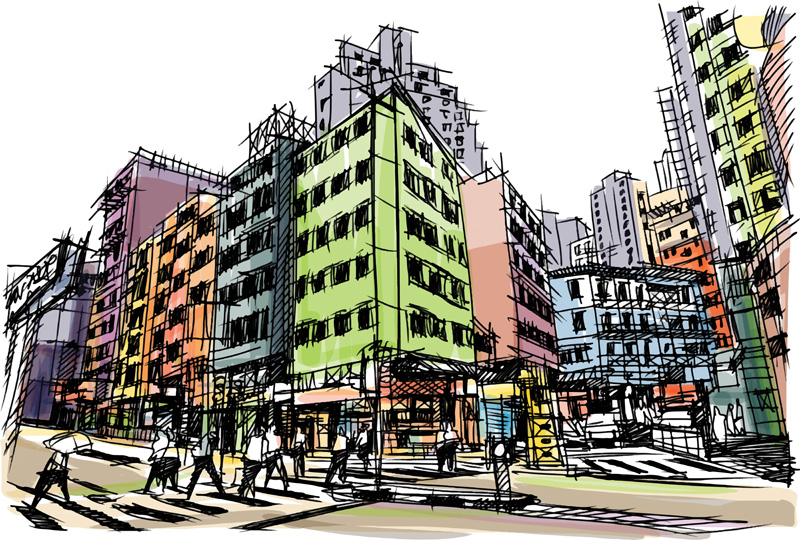
As a place where East meets West, Hong Kong has a distinct literature which does not resemble that of other Chinese cities.
The Department of Chinese and History (CAH) of CityU’s College of Liberal Arts and Social Sciences recently organised the “City Literary Awards 2020” to develop the standard of Chinese creative writing among Hong Kong’s younger generation. It is intriguing to explore the topic of “city literature”.
There are many genres of literature. Genres can be defined according to different attributes, such as the period in which the works were composed, and their tone, style, form or content. Usually, there are subgenres within a major genre. For example, Chinese works are often categorised by dynasty, like the pre-Qin, Wei and Jin, Ming and Qing dynasties. In each period, different subgenres were derived. Examples include temple literature, aristocratic literature and feminist literature.
In short, a new genre is born when we add an attribute before the word “l(fā)iterature”. So is city literature—it evolved from adding “city” before “l(fā)iterature”. But the addition has its point. Dr CHAN Hok-yin, Associate Head and Associate Professor of CAH and the chairperson of the organising committee of the “City Literary Awards 2020”, explains what makes city literature unique.
“The world is becoming more globalised. People travel more frequently than ever before. With various forms of literature such as poems, prose, novels and drama, we can record the cultural activities and human interaction, and depict the lives of different people within a city.” As a place where East meets West and modern blends with traditional, Hong Kong has a distinct literature which does not resemble that of other Chinese cities. “It has its very own social properties, collective memory, cultural dimensions and wisdom,” Chan adds.
Hong Kong has rich literary resources and works. The history and development of Hong Kong literature are well documented in Compendium of Hong Kong Literature, a 12-volume series edited by Professor CHAN Kwok-kou, a literary critic, comparative literature and Hong Kong literature expert. Hong Kong writers DUNG Kai-cheung, LEUNG Ping-kwan (whose pen name was Ye-si) and David WONG Derwei have also evoked the vibrant local literary scene in their works.
In his school days, Chan was not an enthusiast of literature, which he now teaches and promotes. “I studied science subjects in secondary school and rarely read literary works. Probably the only piece of Hong Kong literature I read before the university was an article in the curriculum written by Xi-xi, which portrays the wide variety of shops on the streets and the people who shop there.” It was only after he enrolled at university that he gained more exposure to Hong Kong literature. He read a lot of works composed by local writers and poets including WU Yin-ching, LIU Yichang, WONG Bik-wan and CHEN Zhide, and learnt to appreciate the finesse in these works.
For Chan, local literature reflects social issues in our society. “These works represent the thoughts and ideas of many Hongkongers. By reading these works, the younger generation can rethink the many facets of Hong Kong and develop a deeper insight into this metropolis, which grew out of a small fishing village,” he says.
Literature does not excite young people in Hong Kong the same way it did a decade ago. “Eight or 10 years ago, I met groups of students who were really passionate about literature. They wrote articles, ran reading groups, and even printed their own literary magazines. These days, students seldom read literary works, and few join our literature talks or workshops out of interest. They usually attend because they are required [to do so] by their teachers or parents,” Chan says. “There are very few research studies in Hong Kong or city literature within academia, too. Few journals publish relevant papers. It hinders research in this field.”
Fortunately, many passionate writers and educators are determined to promote literature in Hong Kong. Platforms for exchanging and showcasing creative works are well established.
“Hong Kong Biennial Awards for Chinese Literature” is one of these platforms. It was conceived in 1991 by Hong Kong Public Libraries, and many local authors have started their writing career after receiving an award in this competition. Literary magazines such as the bi-monthly Fleurs des Lettres, the three magazines under the Hong Kong Pupil Literature Monthly Magazine series edited by Hong Kong writer KWUN Moon-nam, and the 35-year-old Hong Kong Literary magazine help tremendously in nurturing young writers, elevating students’ writing skills and bringing Hong Kong literature to the world.
Chan has played a major role in promoting Hong Kong literature. In university, he was a production team member for CityU’s literary magazine, and was also a judge for competitions in the “City Literary Festival”. In recent years, he has hosted seminars and workshops on novel and prose writing together with CHAN Chi-kian and YAN Puikei, both local writers and teachers in secondary schools. They were also members of the organising committee for a micro-novel writing competition in 2017 and the “City Literary Awards” this year.
For those aspiring to write about Hong Kong, Chan has some practical advice: “Not only is this an international financial hub, it is a lively and ever-changing metropolis. By observing the people and what’s happening around us, and experiencing the city’s culture, history and daily living, one may get inspired.”