To protect the marine ecological environment and facilitate the sustainable development of the marine economy in Hong Kong, a CityU-led marine research team has developed a new aquaculture technique by establishing a floating, indoor weatherproof fish farm with a seawater recirculating system to replace conventional fish rafts. The promising results, including increased productivity and improved food safety, will contribute to supporting the livelihood of fish farmers and revitalising the local marine culture industry.
Hong Kong’s traditional marine aquaculture industry, which provides about 5% of local demand for live marine fish, relies on good seawater quality in designated fish culture zones and their surroundings. One main challenge faced in recent years is the frequency and occurrence of harmful algal blooms, commonly referred to as “red tides”, which cause oxygen depletion in seawater and the death of farmed fish. Toxic algal blooms spreading across Hong Kong waters in 1998 and 2015 resulted in massive fish kills and economic losses. The seasonal occurrence of parasites, followed by microbial infections, also put stress on cultured fish. Juveniles (i.e. fish fry) are particularly vulnerable.
Addressing the threat of red tides
These incidents have discouraged local fish farmers from investing in cultivating fish fry. Many fish rafts were abandoned or their operators were forced to switch their usage to recreational activities.
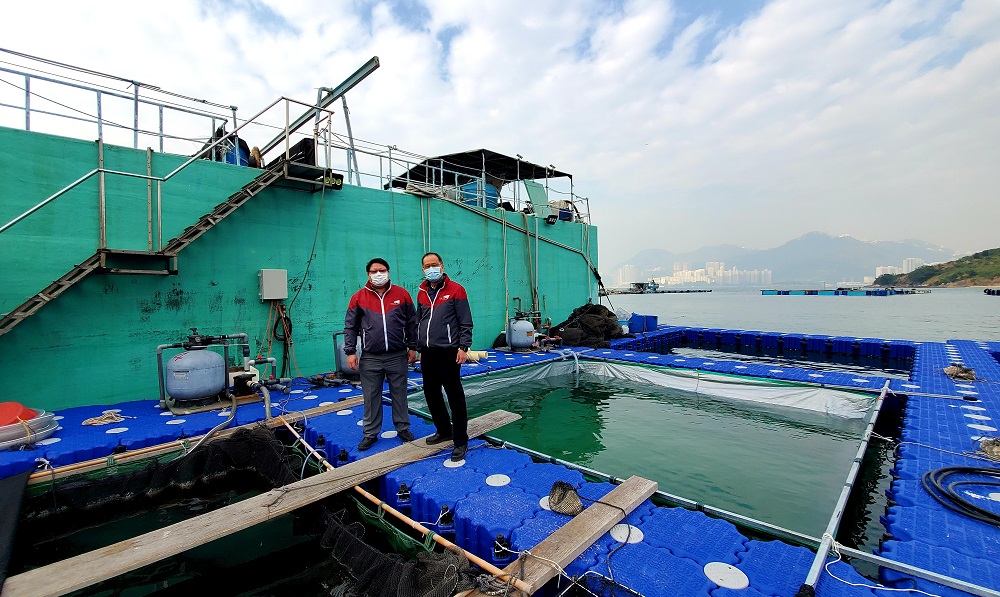
Supported by Sustainable Fisheries Development Fund from the Agriculture, Fisheries and Conservation Department, the team from the State Key Laboratory of Marine Pollution (SKLMP) at CityU worked on developing better culture techniques for raising the juveniles of fish like the giant grouper (Epinephelus lanceolatus) with the use of a seawater recirculating system, housed inside a floating fish farm. There are three main decks inside this floating fish farm: the lowest deck houses a complex water-filtration system, and the other two are “fish fry chambers”, which consist of tanks for raising fish fry. The new techniques have demonstrated encouraging results by reducing the chance of microbial and parasitic infections, as well as the use of antibiotics.
A batch of giant grouper fry, which the research team has reared in the fish fry chamber for three months since August 2020, has a survival rate of nearly 100%. No apparent microbial or parasitic infections have been recorded. This represents a remarkable improvement compared to what is commonly seen in open-sea-cage fish rafts without a seawater filtration system, with 30% or above mortality of newly imported fish fry.
In addition, the issue of antimicrobial resistance can be mitigated. Fish cultured under these conditions are safer for human consumption, as less or even no medical treatment such as antibiotics is needed.
Improvement in fish and marine health
The productivity of fish rafts has also increased with the use of new fish feed. Instead of using trash fish, the team uses only dry pellet feed, which significantly reduces pollution caused by traditional fish feed and improves both feed efficiency and fish health.
“This project is a very good example of the One Health concept, how we can achieve optimal health for humans, animals and the ecosystem with technologies and innovations,” said Professor Paul Kwan-sing Lam, Jeanie Hu Professor of Science, Chair Professor in the Department of Chemistry and SKLMP member, who led the study. The team plans to demonstrate these techniques to local fish farmers and supply healthy fish fry to them. The “fish fry chamber” concept can be adopted in any fish culture zone in Hong Kong and other places in Asia.
Established in 2009, the SKLMP is a consortium of seven universities, with CityU the leading institute. “Capitalising on a multi-disciplinary team and its collective expertise, we strive to protect the marine environment of Hong Kong and southern China by identifying major threats, such as harmful algal blooms and contaminants of emerging environmental concern, and developing tools, technologies and policies to address these problems,” said Professor Kenneth Mei-yee Leung, Director of the SKLMP. “We look forward to more collaboration with different institutions and laboratories, as well as the industry, to tackle the complex environmental challenges together.”
To support marine water quality management in the Greater China region and beyond, SKLMP also endeavours to scientifically derive water quality criteria (WQC) for chemical contaminants that represent safe environmental concentrations at or below which the marine ecosystem is safeguarded. For instance, Professors Lam and Leung recently established a set of interim WQC for 21 chemicals of emerging concern to help protect marine ecosystems in the Greater Bay Area of China. Professor Leung has also helped the international Nickel Producers Environmental Research Association (NiPERA) generate toxicity data with tropical marine organisms and derive the WQC of nickel for the Southeast Asia and Melanesia regions.

This research article originated from CityU RESEARCH.