Graphene, also known as the “black gold”, is the thinnest material in the world with just a single layer of carbon atoms. Not only cannot be seen with the naked eye, but it is also extremely difficult for scientists to test the actual mechanical properties of free-standing graphene. A research team comprising scientists from City University of Hong Kong (CityU) and Tsinghua University has achieved a breakthrough in this aspect. They developed a unique nanomechanical testing platform and revealed the realistic strength and stretchability of monolayer graphene for the first time. The discovery established the actual mechanical property standards of graphene, which will promote its application in flexible electronics and engineering.
Their findings were published in the international journal Nature Communications, titled “Elastic straining of free-standing monolayer graphene”. The paper was later highlighted by “Editors’ Choice” in Science.
With its unusual physical properties, graphene can probably replace many important materials in existing technology applications. “Ideally, graphene has six outstanding properties: thin, flexible, transparent, strong, electrically conductive, and heat conductive. It can be regarded as a futuristic material. In our research, we focus on finding out its actual flexibility and strength,” said Dr Yang Lu, a specialist in nanomechanics and Associate Professor of the Department of Mechanical Engineering at CityU, who led the study.
How strong is graphene in reality?
Before this study, Professor James Hone and colleague from Columbia University used nanoindentation in an atomic force microscope to reveal the intrinsic mechanical properties of graphene, demonstrating the ultimate strength up to 130 GPa. This research established graphene as the strongest material ever measured. Dr Lu pointed out that the above research has provided the local maximum stress that can be withstood at a certain point on a sheet of graphene. “However, we also need to consider boundaries and edge defects of a large-area graphene monolayer if we are to use it for actual engineering applications. There should be a difference between realistic value and the ideal limit of the mechanical properties,” said Dr Lu.
In his view, a more straightforward way to measure graphene’s practical mechanical properties should be tensile stretching a large piece of free-standing monolayer graphene, which is much closer to the realistic loading conditions, such as in flexible electronics and nano-composites.
To achieve this, Dr Lu and his team designed and performed in situ tensile tests on free-standing graphene. However, they encountered quite some difficulties because of the material’s monolayer nature. “Firstly, we need to seamlessly transfer a large piece of graphene onto our nanomechanical platform. We have also developed a technique to control the shape of graphene samples by precisely cutting it with a focused ion beam. After we fabricated the high-quality and free-standing graphene samples, we then performed quantitative tensile tests and monitored the deformation status in real time by scanning electron microscope. Overcoming the technical challenges during the whole process took us over three years,” explained Dr Lu.
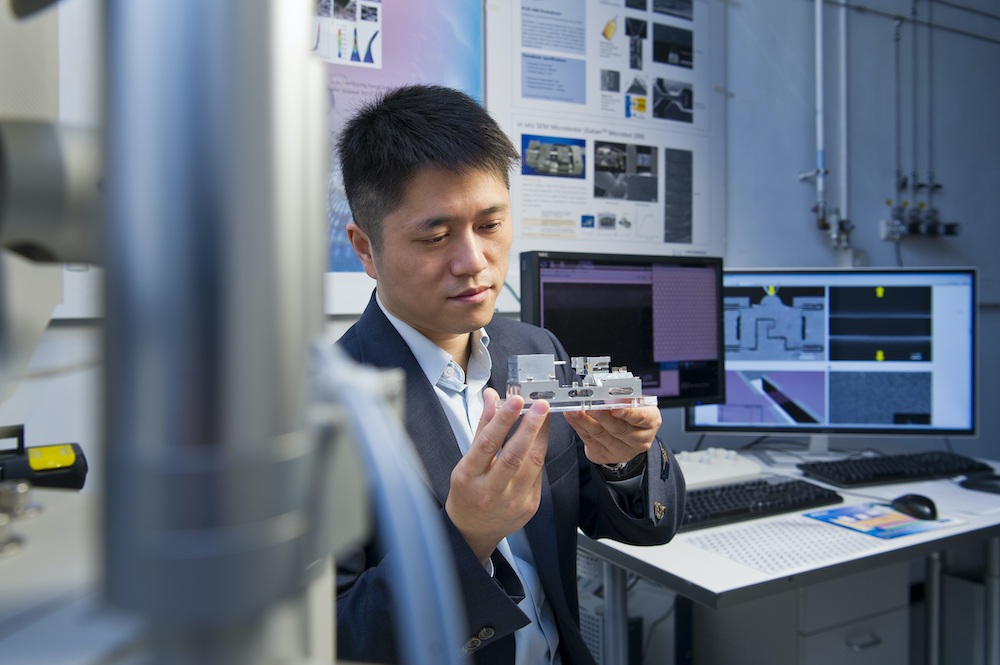
“The most time-consuming part in our research is to transfer the extremely thin monolayer graphene sample after it has grown on the surface of copper foil and lay it onto the testing platform without damage,” Dr Lu added. He was grateful for the support from Dr Thuc-hue Ly, Assistant Professor in the Department of Chemistry, in the transferring process so that they “managed to develop a new protocol for sample transfer”. With Dr Lu and his lab’s rich experiences in testing various nanomaterials, the team has also overcome various difficulties in the experimental design.

“It was an achievement of interdisciplinary collaboration of CityU experts from different fields,” he said.
Realistic mechanical properties of graphene revealed
By using the abovementioned technique and the testing platform, tensile tests were performed on the suspended graphene monolayers inside a scanning electron microscope. The experiment has revealed the realistic mechanical properties of graphene in situ.
The experiment showed that the fully recoverable elasticity of chemical vapour deposition (CVD)-grown monolayer graphene can be about 5%, with maximum tensile elastic strain up to 6%. Moreover, the measured Young’s modulus is 920 GPa, which is very close to the theoretical value of about 1,000 GPa. Moreover, the sample-wide tensile strength can reach 50 to 60?GPa, about half of the theoretical value of 130 GPa, proving that large-area monolayer graphene is indeed an extremely strong material.

Movie of graphene sample under elastic stretching. (DOI: 10.1038/s41467-019-14130-0)
Dr Lu elaborated that these results have reflected that high-quality CVD graphene reached not only the level of “ultra-strength” (meanings its actual tensile strength reaches one-tenth of the theoretical value) but also “deep ultra-strength” (actual tensile strength reaches half of the theoretical value). “If a material can overall reach the state of deep ultra-strength, it may have unexpected new physical properties,” said Dr Lu.
Next step: graphene devices by elastic strain engineering
Dr Lu pointed out that when designing the application of a material, one cannot only consider its theoretical value. It is essential to know the actual mechanical properties of the material through experiments. With their reveal of the realistic mechanical properties of graphene, the research team hoped that these data could facilitate the practical application of graphene in different aspects. For example, they can be applied in manufacturing flexible touch screens, wearable electronic devices, solar cells, sensors in biomedical engineering, or even fabricating into a light but strong nano-composite for aviation and defence technologies.

“We now know that graphene can withstand extremely large lattice deformation. Then we can control the lattice strain precisely through the concept of elastic strain engineering for the novel application of graphene or other two-dimensional materials in future electronic or optoelectronic devices,” added Dr Lu.
Dr Lu and Professor Zhiping Xu from Tsinghua University’s Department of Engineering Mechanics are the corresponding authors of the paper. The first authors of the paper are research associate and Dr Lu’s former PhD student Ke Cao and PhD student Ying Han from CityU’s Department of Mechanical Engineering, as well as Shizhe Feng, PhD student from Tsinghua University. CityU members of the research team also included Dr Thuc-hue Ly and Dr Libo Gao, a PhD graduate from the Department of Mechanical Engineering, currently an Associate Professor from the School of Mechano-Electronic Engineering, Xidian University.
The research was supported by CityU, Research Grants Council of Hong Kong, and the National Natural Science Foundation of China.
DOI number: 10.1038/s41467-019-14130-0
Graphene opened the new door of two-dimensional material
Graphene is the world's first two-dimensional material. It was successfully “peeled off” from graphite by two physicists, Professor Andre Geim and Professor Konstantin Novoselov. They studied graphene’s properties and were awarded the 2010 Nobel Prize in Physics.
Ten years later in 2020, another three physicists, Professor Pablo Jarillo-Herrero, Professor Allan H. MacDonald, and Dr Rafi Bistritzer were awarded the Physics Prize of the Wolf Prize (widely considered a prediction for the Nobel Prize) for their theoretical and experimental research on double-layer graphene. They discovered that by placing one sheet of graphene over another, rotating the other sheet to a special orientation of 1.1 degrees, (known as the “magic angle”), and then placing them under a low temperature of 1.7K (-271.45 degrees Celsius), graphene would be turned into a superconducting material with no resistance at all.
“This shows that even for the same material, new properties can be discovered with only a slight change in the geometrical settings of its lattice. We will continue to study the elastic straining effects of monolayer and double-layer graphene, and try to control the geometric strain of the lattice through our nanomechanics approach to see if there is any new surprise,” said Dr Lu.
This research article originated from CityU Research Stories.