
In the world of nanomaterials, when the “upconversion luminescence” material is excited by low-energy light, it can emit high-energy light, such as ultraviolet light. However, the emission intensity is not satisfied and hence limiting the further applications in different fields. A research team jointly led by the Materials Science and Engineering and Physics departments of City University of Hong Kong (CityU) has proposed a new strategy and successfully achieved upconversion luminescence with high energy conversion efficiency. The team believes that the research result will help further development and applications in miniaturized optoelectronic devices.
Conventional fluorescent materials become fluorescent by absorbing the light with shorter wavelength and higher energy, and then emitting the light with lower energy and longer wavelength. "Photon upconversion" is just the opposite. It refers to the process of absorbing two or more photons with longer wavelength and lower energy, and then emitting light at shorter wavelength and higher energy. It is an anti-Stokes process. One example of this type of luminescence is the conversion of near-infrared light into visible light.
Currently, lanthanide-doped upconversion nanomaterials can convert low energy, long wavelength near-infrared photons into visible ultraviolet photons (high energy and shorter wavelength) through multiphoton process. However, the luminescent efficiency is still limited. One of the solutions is to increase the dopant concentration by doping more optical centers in the host materials. But this will encounter another problem: the high dopant concentration will result in “concentration quenching”, meaning that the more dopant ions are doped, the more energy is dissipated as heat, and the intensity of luminescence is thus less.
To overcome this challenge, a research team led by Dr Feng Wang, Associate Professor at Department of Materials Science and Engineering and Dr Sai-tak Chu, Associate Professor at Department of Physics at CityU has unraveled a new strategy based on combined use of core-shell strategy and a microring resonator-assisted excitation platform. They have found that the core-shell nanostructured particles can effectively alleviate the concentration quenching and the microring resonator can significantly enhance the excitation, and thus a high energy conversion efficiency over 5% is achieved under excitation at 1550 nm. They further successfully achieved the upconversion luminescence at a very low excitation power (20 μW), converting low-energy, long-wavelength (1550 nm) photons to high-energy, low-wavelength (380 nm) ultraviolet photons, with the anti-Stokes shift of over 1150 nm for micropatterning applications.
The findings were published in Nature Communications, titled “Integrating temporal and spatial control of electronic transitions for bright multiphoton upconversion”.

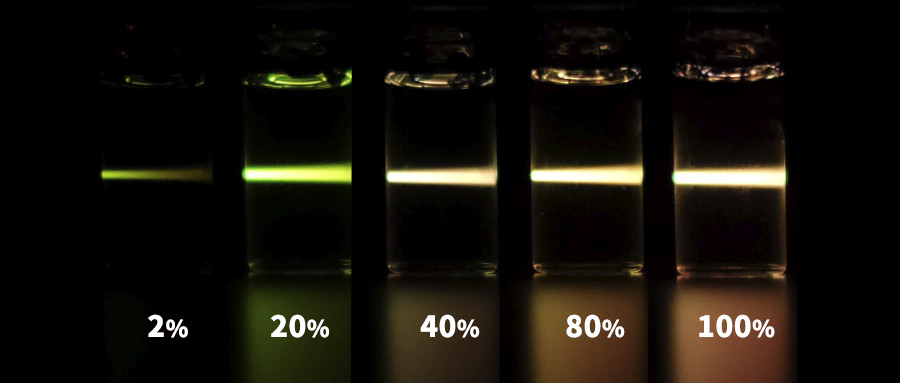
The team found that the concentration quenching of individual excited state is dominated by different processes. They also found that using nanoparticles with a core-shell nanostructure as a host, the outer shell of the nanoparticle can effectively reduce the concentration quenching effect. Then they use the microring resonator to successfully improve the excitation efficiency and hence increase the upconversion luminescence intensity, especially the ultraviolet regime.

“The success in achieving bright upconversion emission by excitation in the wavelength range for optical communication would largely promote practical applications for these nanoparticles, says Dr Wang.
“Many inexpensive and high-performance lasers and optical components can be readily acquired from the mature telecommunications industry. So we believe our findings can help stimulate the development of novel miniaturized optoelectronic devices,” adds Dr Chu.
Both Dr Wang and Dr Chu are the correspondence authors. The first authors are Dr Tianying Sun and Yuhua Li from CityU. Other authors include PhD students Wai-lok Ho, Qi Zhu and Xian Chen, as well as researchers from Harbin Institute of Technology (Shenzhen), Xiamen Institute of Rare-earth Materials, The Hong Kong Polytechnic University, Changchun Institute of Applied Chemistry, and Xi’an Institute of Optics and Precision Materials.

This research article originated from CityU Research Stories.