


A Successful Journey into Multimodal Imaging Methods Across the World
Social scientist Dr TSE Chun-yu recounts his journey and experiences in b rain imaging and the pioneering advances made in this field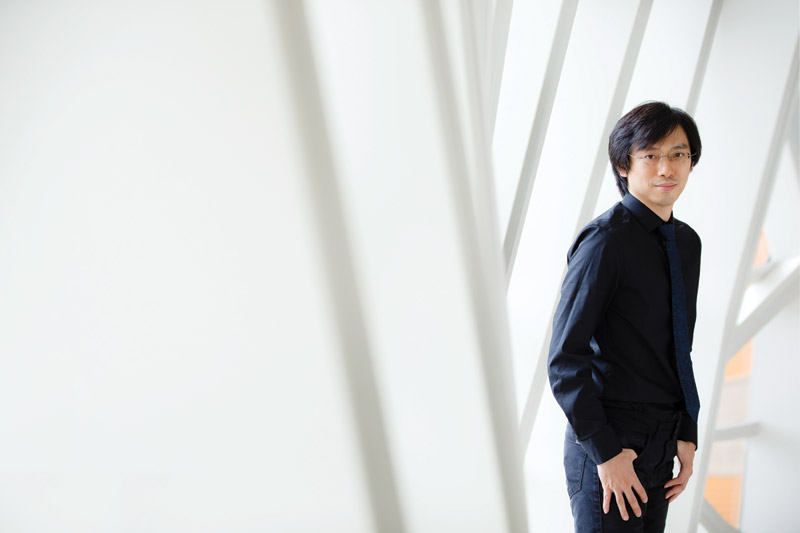
Dr Tse Chun-yu has been delving into the study of the brain and human mind through brain imaging and brain stimulation.
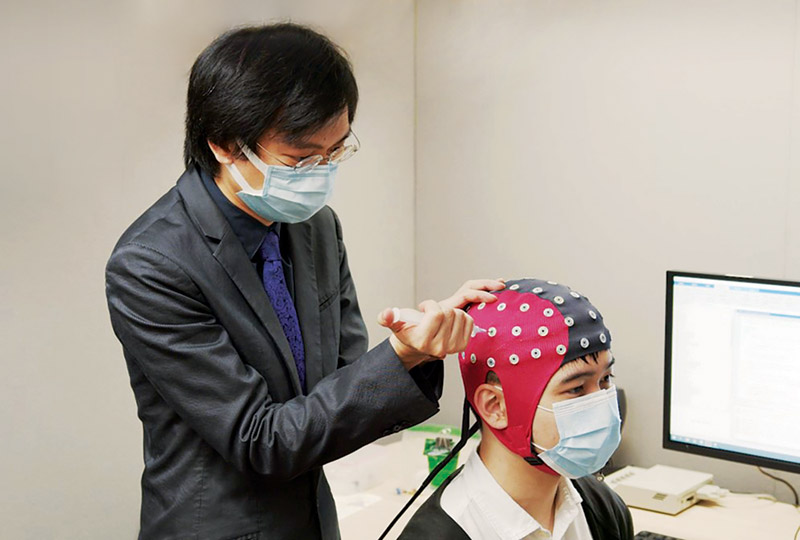
To record EEG, the participant of the study needs to wear a cap with embedded sensors. Gel is used to increase electrical conductivity.
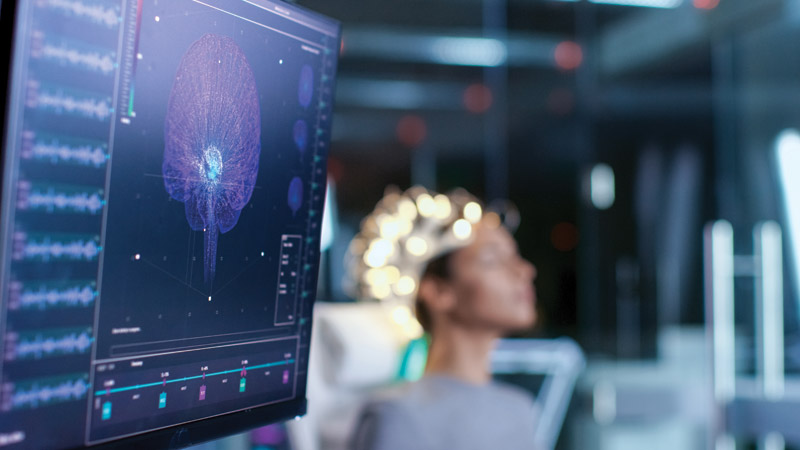
Brain imaging unveils the human mind which cannot be understood through studying one’s behaviours or verbal responses.
Now Assistant Professor at CityU’s Department of Social and Behavioural Sciences, Dr TSE Chun-yu started his studies focusing on medicine, before eventually moving on to psychology. He already had a very specific field in mind that he wished to work in – cognitive neuroscience: the study of the brain and human mind through brain imaging and brain stimulation.
His journey into brain science took him from Hong Kong to the United States, to Singapore and then back to Hong Kong.
Tse studies the cognitive and neural architecture of the automatic/ pre-attentive change detection system in humans for the normal, ageing and clinical populations. He explains his research interests as examining “the memory and attention processes involved in detecting changes in the environment and neural substrates underlying those processes”. His work has delved into the application of multimodal brain imaging and stimulation methods that include electroencephalography (EEG), event-related optical signals (EROS), fast optical signals (FOS), magnetic resonance imaging (MRI), and transcranial magnetic stimulation (TMS).
He earned his PhD in psychology from the University of Illinois at Urbana-Champaign in 2010 after obtaining his undergraduate and master degrees in Hong Kong.
Of Man and Brain-imaging Machine
“There were two major types of optical brain imaging methods,” Tse elaborates. “One of them is called the functional NIRS (near-infrared spectroscopy). The other neuroimaging technique is the one that we are using, which is one that I’m more interested and specialised in – the EROS. The (optical brain imaging) method that I use is actually developed in Illinois,” he says. “It is the reason why I went there for my doctorate. When I was in my master’s programme I developed an interest in brain imaging; however, I don’t know how to proceed. At the time, the university had just bought an EROS machine. The machine remained in its box, lying around. Even my master’s thesis supervisor did not know how to use it. My supervisor said to me, ‘Oh, you want to learn brain imaging, how about start with EROS?’ OK, then I take it out of the box and figure out how to assemble it.”
Innovation is important. But if your work involves using very advanced technology in the more humanistic area, the actual challenge is that you need to be able to explain it to people
Dr Tse Chun-yu
Tse did exactly that, building the machine piece by piece and discovering how optical brain imaging worked. “By communicating with my PhD supervisor during my master’s study through email, that’s how we got to work with each other.” And so his trip to Illinois came about.
“When I got into this area, it was actually still developing; a lot of things were unknown” he says. “Later, I realised that what I discovered is not specific to the optical method, but the universal principles governing how brain imaging works, and helping me to quickly master many other imaging methods, like EEG and MRI, and see through the relationships between different methods,” he added. “It is difficult for me to define my work by a particular method, though my optical works shine. Outsiders love to define academics in this area by the method that they use, like an EEG or MRI person, but it is an old-fashioned way. The frontier is integrating different types of brain imaging methods and brain stimulation to answer research questions that we have.”
While working on his PhD, Tse got wind that his supervisor’s team had acquired a brain stimulator. Upon hearing this news, a research idea hatched within Tse. “I wanted a chance to chat with my supervisor because I had the idea to combine the optical brain imaging and brain stimulation methods, and I needed support to do that.”
Tse caught his supervisor during a coffee break and presented him with the idea. “Unfortunately, he didn’t let me do the project at the time. He said that I already had too many projects and I was heavily involved in a different research project.”
Putting Long-Awaited Research into Practice
Though deeply disappointed, Tse would find another opportunity when he had joined Temasek Laboratories at the National University of Singapore as a research scientist (post-doctoral fellow). While he and his new team already possessed an optical machine, they wanted to get their hands on a TMS machine. However, in Singapore, Tse explains, people were cautious when it came to brain stimulators. “Research has shown that the use of brain stimulators is safe if you follow the guidelines. However, people there are more on the cautious side.”
Things had to go full circle before Tse could finally put his long-awaited research to practice. “It wasn’t until I returned to Hong Kong that I was able to carry out my research – when I had my own lab and I could sell my own research directions.”
This occurred in 2013 when Tse joined the Department of Psychology of The Chinese University of Hong Kong.
Even then, the life of a psychology researcher was not straightforward. Academic funding does not support the purchase of equipment, only the cost of research. As such, the TMS machine on which Tse had set his sights so many years ago would have to be acquired through the university.
Finally, a few years after Tse returned to Hong Kong, a tangible chance presented itself. “One of my collaborators knew the manufacturer. He presented my research idea to them, which is combining the optical and the brain stimulator, and they decided to give me the equipment at an extremely discounted price.”
When Persistence and Research Finally Yield Success
Despite the challenges, everything seems to have finally fallen into place for Tse, who joined City University of Hong Kong last year. Perseverance is an important trait for today’s academics – that and the ability to clearly communicate one’s research.
“Innovation is important. But if your work involves using very advanced technology while you work in the more humanistic area, the actual challenge is that you need to be able to explain it to people. How do you use the machine? Why is that different from the traditional way? What is the scientific knowledge we can get from it? Ultimately, it is the kind of knowledge that you cannot get from traditional research methods, and there is the real challenge.”
The academic community is a multinational community, Tse concludes, and looks back at his own experience in different cultural environments. “The more people you meet, the more you understand about people with different cultural backgrounds, and that is a part you need to deal with.”
“In our professions there are different groups we collaborate with from many different areas: engineers, medical doctors, linguists… They have their own thinking and own culture. We have a lot of collaborations. That’s why we need to be able to talk to different people and understand that.”