Renowned Turkish writer,
Mr Orhan Pamuk, concluded the Distinguished Lecture Series with a discussion on Ottoman painting and the influence of Western art on Eastern painting—the predominant theme of his prize winning novel,
My Name Is Red. His lecture attracted a full house at the Wei Hing Theatre, 25 November.
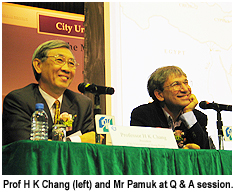
Kicking off the event, CityU President Professor H K Chang recounted his encounter with Mr Pamuk in Istanbul in January this year and explained why he invited him to speak at the Distinguished Lecture Series. “I found him to be a very interesting personality and a very dynamic speaker, in addition to being a talented author.”
Moreover, in conformity with the policy recommendation of the Culture and Heritage Commission, HKSAR, which Professor Chang heads, having a guest speaker from a non-English speaking country, such as
Turkey, will add cultural diversity and vitality to
Hong Kong. Professor Chang wrote an article about his interest in
My Name Is Red, Islam and Islamic culture, entitled
“From Hajj Baba to My Name is Red: A Personal Journey” published in the latest issue of
Ex/change, a publication of CityU’s Centre of Cross-Cultural Studies. A Chinese translated and abridged version of which was published in
Ming Pao recently.
The book My Name is Red took Mr Pamuk 12 years to complete, from the initial ideas and development through to research and publication. Four of those years were spent entirely on writing the novel. The idea for the story is closely related to his childhood ambition to become a painter. Born in 1952 to a large family in a wealthy westernized district of Istanbul, Mr Pamuk dreamed of becoming an artist from early childhood to the age of 22, during which time he devoted himself to painting. He studied architecture at Istanbul Technical
University for three years, but abandoned the course when “for some strange reasons” he gave up his ambition to become an architect and artist. Instead he went on to graduate in journalism from
Istanbul University, but never worked as a journalist. At the age of 23, he decided to become a novelist, and retreated into his flat and began to write. He has explained his decision to give up his dream in his latest book
Istanbul, a poetical work combining his early memoirs up to the age of 22.
Mr Pamuk has published seven novels and one screenplay. My Name is Red was published in 1998 and over 160,000 copies have been sold in Turkey. It won the French Prix Du Meilleur Livre Etranger, the Italian Grinzane Cavour (2002) and the International IMPAC Dublin literary award (2003). The novel has been translated into more than 20 languages. It has won wide acclaim as both a page-turning thriller and a philosophical puzzle on art, love, religion and power.

“My Name is Red is essentially about painters, about the Eastern and Western ways of seeing,” said Mr Pamuk. Set in 16th century Istanbul, the story involves the Sultan secretly commissioning a cadre of the most acclaimed miniaturists to create a book celebrating the glories of his empire. But their task is to illuminate the work in the European style of portrait painting, an act which could be an affront to traditional Ottoman art and to Islam. Panic erupts when one of the chosen miniaturists is murdered and the murderer is suspected to be among the other miniaturists. Did the artist fall victim to professional rivalry, romantic jealousy or religious terror?
“It is a comparative analysis of Eastern and Western ways of seeing,” Mr Pamuk reiterated. It is also a dramatization of the concept of style in Eastern and Western art. According to the novel, traditional Ottoman paintings stand not as themselves but strictly as illustrations of text. They are small, miniature in scale, and the figures depicted are without individual expressions. Indeed, painting is an act of memory and blindness is the ideal condition for creating pure art. As for the Renaissance portrait painting, figures are individuals and are depicted as they are in real life. They stand as works of art in their own right. Great paintings are distinguished for their individual styles. “It is an essential human desire to get your face on paper as you are, then you can say that you are different, you have a signature,” said Mr Pamuk. “That reinvented the mental map for the whole humanity.” He added that one strong motivating force behind the Italian Renaissance was the princes’ desires to have their faces preserved for eternity.
To dramatize such themes of profundity and to make the novel interesting, Mr Pamuk presents a murder mystery-cum-love story told by a dozen characters in the first person narration. A dog, a tree, a gold coin, several corpses and the color red make their voices heard. He even blends in personal history to give the novel an extra dimension of fun and heart-felt warmth. For instance, he uses his name, Orhan, his brother’s name, Shevket, and his mother’s name, Shekure, for three of the characters. The stories of these fictional characters bear a close resemblance to real characters in Pamuk’s life.
The animated lecture inspired an enthusiastic response from the audience in the Q and A session, with questions raised on issues such as East and West tension, literary styles and the meaning of the color of red. The lecture concluded in a spirited interaction between the author and his readers.


