The maintenance of old buildings and the disposal of building materials are the key areas of focus in today’s construction industry. In particular, new building materials and structural assessment technologies need to be durable, cost effective and environmental friendly. These issues were addressed at the third technology transfer forum “Structural engineering for cost saving”, co-organized by CityU and the
Hong Kong Productivity Council on 21 May.
“CityU is strong and innovative in technological research," said
Mr H Y Wong, Director of CityU’s
Technology Transfer Office. "With firm commitments to transferring our research output to society, we are proud to present our latest technologies and hope building and construction practitioners can make full use of it.”
Guest-of-honor Mr Yue Chi-hang, JP, Director of the Department of Architectural Services added Hong Kong was an international city with many high-rises and skyscrapers. "Structural engineering and construction technology has developed rapidly and effective budget management can help maintain the competitiveness of Hong Kong,” he said.
Other guests included
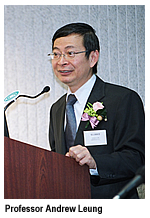
Professor Andrew Leung, Head of CityU’s
Department of Building and Construction (BC) and
Dr Stephen Lee, Branch Director of the Hong Kong Productivity Council.
Professor Leung said that Hong Kong lacked effective structural monitoring systems. "As the maintenance of old buildings and infrastructures has become a major concern, early warning regarding overall integrity of structures is of great importance to minimize the possibility of risks.”
“Through the Forum, we aim to alert the industry about the latest technology in this area and discuss how new materials like polymers, self-compacting concrete, and Rapidwall can provide an alternative to conventional vibrated concrete,” he continued.
Dr Joseph Wong, Laboratory Manager of BC, said the need for structural assessment had increased in recent years, especially when reinforced concrete structures in many cities were approaching the end of their life span.
During the session, Dr Wong discussed key aspects of structural integrity assessment, and examined how to reduce costing during the implementation and selection stages of construction. His talk also presented the technological differences between static and dynamic methods and the knowledge of choice of sensors and methods for checking different types of structures.
One of the central problems facing the industry is steel reinforcing bars are prone to corrosion when they are in contact with air and water. In addition, traditional concrete is non-homogeneous and viscous in nature, which means, if the concrete is not properly compacted, cracks, voids and gaps could be formed.
Dr Brian Leung and
Dr Alfred Au, both Lecturer in BC, discussed replacing steel and normal concrete by non-ferrous materials-----fibre reinforced polymer (FRP) and self-compacting concrete (SCC). FRPs as structural components were first adopted by the aerospace industry due to their excellent strength-to-weight ratio. They are five times lighter but four times stronger than steel and potential applications include main reinforcement, structural strengthening, concrete confinement and pre-stressing, plus full FRP structures.
Self-Compacting Concrete (SCC), a new category of high-performance concrete, exhibits a low flowing resistance and a moderate viscosity, and can be used to improve the homogeneity of concrete and to insure a proper filling of restricted areas in the absence of vibration. It can reduce noise, shorten construction time, improve quality of in-situ concrete and surface quality.
A further matter is the need for recyclable construction material for sustainable development.
Dr Wu Yufei, Lecturer of BC, introduced a new recyclable building material called Rapidwall. This is a machine-made hollow-core panel fabricated with formulated gypsum-plaster and reinforced with chopped glass-fibre. It is highly durable, can be recycled, and is eco-friendly, economical, lightweight, labor and time effective, and fire and water resistant.
Rapidwall has been used in multi-storey buildings in Sydney, townhouses in Australia and a six-storey residential building in Jinan, Shandong province. It has significant application potential in Hong Kong and the mainland, and the cost of Rapidwall will be further lowered if more companies start using it to replace the traditional concrete.
The technology transfer forum series presents a comprehensive range of CityU's applied research output to identify collaboration opportunities with industrial and business enterprises. Launched in August last year, the forum has covered topics in wireless communication, materials science, and building technologies. As a bridge between the University and the industrial and business communities, the TTO lines up research with consultancy services, licensing technologies, and product commercialization. By collocating the research output in this series, the University fosters practical and effective deployment of technology in the community.