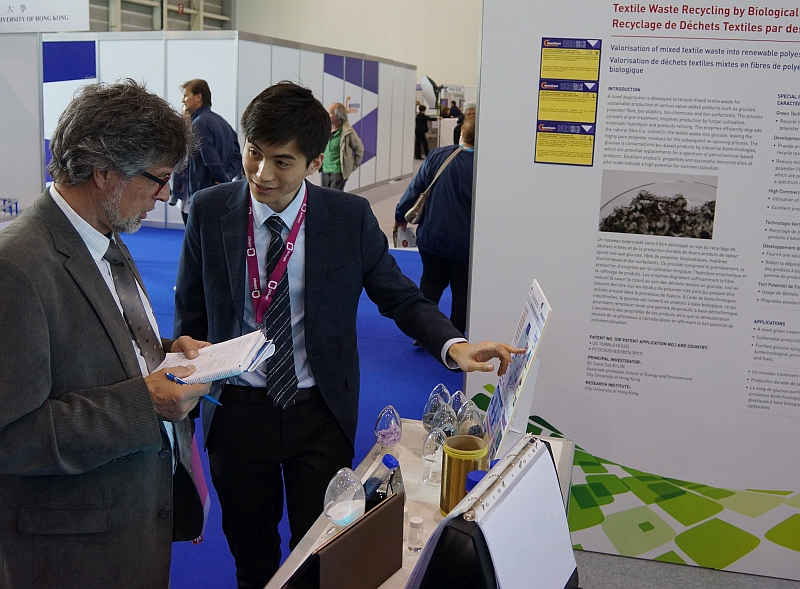
Novel bioprocess for recycling textile waste wins Gold Medal in the International Exhibition of Inventions of Geneva
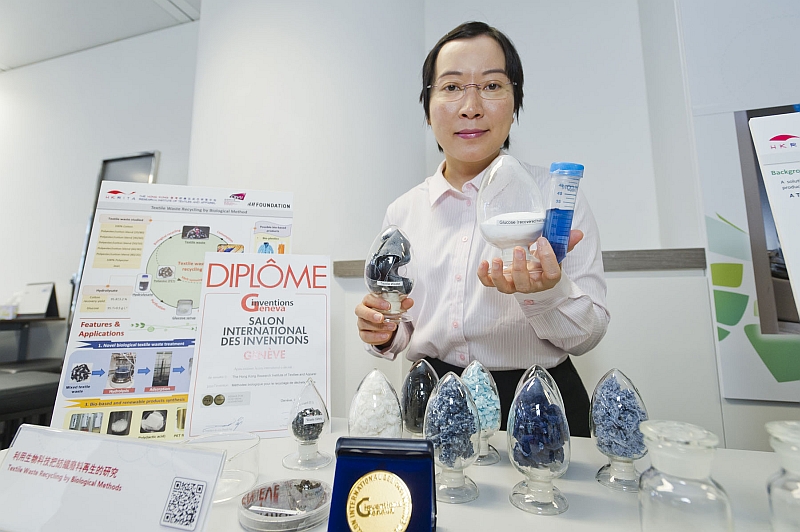
Innovative green technology capable of recycling mixed textile waste into value-added products, such as synthetic fibre and bioplastics, is developed by a researcher team from the School of Energy and Environment (SEE) at City University of Hong Kong. The team recently won a Gold Medal at the 46th International Exhibition of Inventions of Geneva.
The disposal of textile waste has become a global concern in recent years. In 2016, Hong Kong produced around 343 tonnes a day of textile waste, constituting 3.3% of the daily amount of local municipal solid waste that ended up in landfills. In 2014, 16 million tons of textile waste was generated in the US alone, and only 2.62 million tons was recycled, while around 10 million tons was sent to landfills.
“We urgently need a sustainable recycling method for diverting textile waste from landfills,” Dr Carol Lin Sze-ki, Associate Professor in SEE said, whose main research interests include biorefinery, green and sustainable chemistry, and food waste valorization. Hence she and her team started to study the biological method in order to recycle the textile waste into commercially valuable products three years ago.
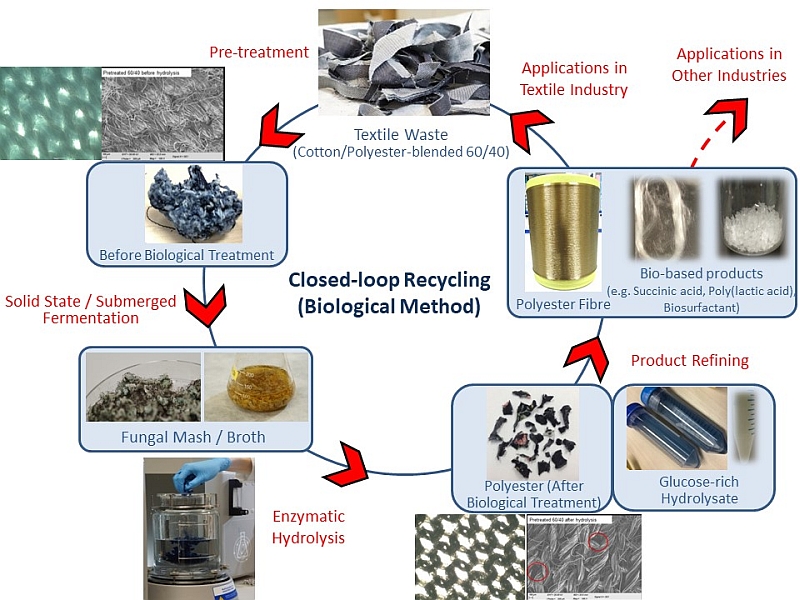
The new bioconversion process that they have developed consists of the following four main steps:
Textiles are usually composed of natural and synthetic fibres, such as cotton and polyester (PET) blends. Their macro-structure prevents the biological catalysts (i.e. enzymes) acting to degrade the natural components during hydrolysis. Therefore, the research team has developed a green and promising pre-treatment method to modify the structure of textile waste with reusable chemicals. This treatment facilitates the reduction of the crystallinity of cellulosic fibre in textiles and enhances its susceptibility to the subsequent hydrolysis.
To produce enzymes for the textile waste hydrolysis, Aspergillus niger CKB is grown on the textile waste. Enzymes are actively secreted in situ by the fungus either through solid state fermentation or submerged fermentation. Microscopic pictures showed the fungus is able to grow on the surface of fibres in a 7-day cultivation under 28℃. The enzymes are then recovered and used in textile waste hydrolysis.
The enzymes solution is thoroughly blended with the pre-treated textile waste, and undergoes hydrolysis in a bioreactor. This process hydrolyses the cotton into soluble glucose, while the non-biodegradable material (e.g. polyester) remains intact and is separated as a solid form by filtration. The hydrolysis is carried out under mild conditions and is completed after 48 hours.
The polyester recovered from hydrolysis is re-spun into polyester fibres which has satisfactory properties for applications in the textile industry, while the hydrolysate is purified by activated carbon to become a glucose-rich syrup. The glucose can be successfully converted into different bio-based products, such as bio-plastics, bio-surfactants (can be used in cleaning agents), and bio-chemicals by industrial biotechnologies.
- Pre-treatment
- Enzyme production by fungal cultivation
- Enzymatic hydrolysis of textile waste
- Product refining
Dr Lin said the major difficulty in textile waste recycling has been that varied compositions are used, which limits regenerated products to low-value applications, e.g. second-hand clothing and basic fibre content. However, the biorefinery strategy that she and her team have proposed is capable of recycling most textiles such as cotton, polyester, jeans, and cotton-polyester blend textiles. Also, the bio-based products derived from textile waste have the potential of replacing fossil fuel resources. “This new bioconversion process can not only help address the waste problem but also create a sustainable and circular economy,” she added.
The 46th International Exhibition of Inventions of Geneva, which was held from 11 to 15 April 2018 was organised under the patronage of the World Intellectual Property Organisation, the Swiss Government and the City of Geneva in Switzerland. It is recognized as the world’s most prestigious innovation exhibition. This year it showcased 1,000 innovations and inventions with more than 800 exhibitors from 40 countries and regions taking part.