OBTL project steps up a gear
Michael Gibb

OBTL is a key project for the University, one that builds upon positive comments in the last two Teaching and Learning Quality Process Reviews in which the University Grants Committee commended CityU for its exemplary Quality Assurance structure.
This new project underlines CityU’s commitment to delivering high-quality programmes and courses to its students.
More than 220 CityU colleagues attended the talk on 11 January at the Wei Hing
The workshops in this third phase run from 16 January to 2 March. They are active sessions that require participants to bring along CILOs for discussion.
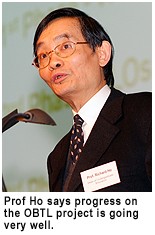
In his opening remarks, Professor (Chair) Richard Ho, Dean of Undergraduate Education (DUE), said he was pleased with the progress of the OBTL project. “Support from colleagues has been very good so far,” he said. To date, 95% of programme ILOS (PILOs) and 1,358 of CILOS had been submitted. CILOs were still being received, he added.
Feedback during the first and second phases of the project had been encouraging, Professor Ho continued. Positive comments from staff said OBTL was useful; a great help to students; could help change the mindset of teaching and learning; and could lead to a “breakthrough” in teaching and learning. Some staff said OBTL was too ambitious; more resources were needed; and the project needed 100% support from the whole University to succeed.
Professor Ho agreed in particular with the last point. The main challenge was to get all departments on board at the same time and that the key to success was flexibility, support and cooperation, he said.
“So I am very pleased that so many colleagues have come here today to show their interest,” he added. In all, 227 colleagues attended.

“It’s the most natural way to learn,” Professor Biggs said, during his 50-minute address.
For example, if a PILO states a student should be able to “solve a problem”, “describe a situation” or “theorize”—these being examples of the learning verbs— the TLA (and, eventually, the assessment task) should provide the student with opportunities to achieve those ILOs.
Table 1 shows some of the different assessment tasks that can match with ILO learning verbs.
The focus on outcomes thus has a direct impact on the way students are assessed: OBTL assessment focuses on how well students achieved ILOs rather than on how they performed on the exam.
“The point is not how you are going to teach but how you want your students to learn,” he said.

Inevitably, this approach implies significant changes to the grading and assessment system currently used at CityU. Traditionally, norm- and criterion-referenced assessments are based on performance in the assessment, but in outcome-referenced assessment (ORA), the grade is awarded on how well the ILOs have been achieved.
“The advantage is that we get a more useful summary of each student’s achievements and employers would love it,” Professor Biggs said. This is a key point: CityU’s mission is to provide a professional education, thus ORA can provide potential employers with vital information that could set CityU students apart from the competition.
In the second part of the talk, members of staff gave feedback on OBTL progress at different levels within the University.
Professor (Chair) K K Lai, Associate Dean of the Faculty of Business, discussed progress at the faculty level; Professor (Chair) Kitipornchai, Head of the Department of Building and Construction, reported from the departmental level; Dr Andy Chan, an associate professor in the Department of Electronic Engineering, offered a view from the programme level; and Professor (Chair) Paul Lam, Associate Dean of the Faculty of Science and Engineering, looked at the course level.
All four speakers said the relevant ILOs had been written, or were in the process of being written, and pilot projects were going into action ahead of schedule, allowing staff to identify gaps, spot areas that could be improved, as well as see what was good about their existing programmes.
Professor Lilian Vrijmoed, Dean of Student Learning, later talked about the learning infrastructure, saying students needed to be involved directly in the OBTL project and that the LASSI and Blackboard initiatives all contributed to helping the project achieve its aims. Professor Vrijmoed said her Office was working closely with DUE to achieve these aims.
At the end of the session, Professor (Chair) Joseph Cheng, the Chairman of the Quality Assurance Committee, said he was encouraged by the session and that the level of support from staff was vital to the success of the project.