Stopping virus spread with better ventilation designs and sewage disposal
Shirley Lam

With the support of Tung On Plumbing Co Ltd, BC set up a 2-storey high sewage and drainage system in the Department laboratory where Dr Yuen and his team study the feasibility of applying a back-inlet arrangement for U-traps of floor drains in Hong Kong. The U-trap, which is built to prevent foul smells and insects in the soil stack from entering toilets, must be filled with water in order to function properly. Practitioners from the construction and plumbing industries are considering the back-inlet arrangement to prevent the U-trap from drying up, by connecting the sink drainpipe to the soil and waste
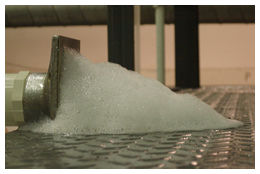
This system is in use in Singapore and some parts of mainland. In theory, Dr Yuen said, it is feasible -- as people wash hands and towels in the sink, there will be a constant flush of water in the sewage pipe. His study, however, discovers that the soap bubbles reflux into the toilet floor via the floor drain. "This makes the floor slippery and unsafe," Dr Yuen said. Singapore tries to solve the problem by increasing the diameter of the floor drain pipe from 1.5 inches to 4 inches. Given the limited and costly land resource in Hong Kong, and the fact that wider pipes only minimize but do not completely prevent the reflux of bubbles, Dr Yuen has reservations about the effectiveness of using thick pipes in Hong Kong.
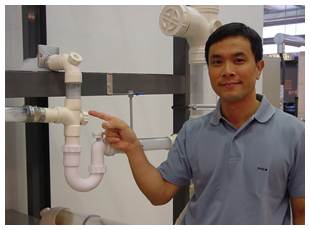
Instead, he explores other alternatives such as repositioning the connection between the U-trap and the waste pipe, and installing a valve-like mechanism in the floor drain to prevent the reflux of bubbles. Dr Yuen is now experimenting with the use of a flap between the floor drain and the U-trap. The flap, installed with a stopper, will allow water to flow out while preventing soap bubbles from flowing back in.
In addition to improving the sewage and drainage systems, Dr Yuen also studies the design of ventilation systems in hospital wards. As "hidden spreaders" are believed to have contaminated the air and triggered the outbreak of the SARS virus in hospitals, an improvement of the air-supply-return configuration in hospital wards is critical. In the "SARS hospital ward airflow distribution study," Dr Yuen applied the Computational Fluid Dynamics (CFD) techniques to gauge the performance of the existing air ventilation systems in hospitals, with an aim to improving the systems and developing a design guideline for future hospitals. "I hope that a boost in the system efficiency will reduce the possibility of patients and medical staff being infected by 'hidden spreaders'," explained Dr Yuen.
CFD involves complex mathematical calculations that provide information about air flow and are commonly used in aerospace and natural gas industries. Dr Yuen has substantial experience in using CFD techniques to carry out the study of smoke and flame spread in buildings. Recently, he applied the technique to removing exhaust air from a shooting range for the government. "A similar theory can be applied to develop a suitable system for hospitals," he said.
The project, jointly conducted by Dr Yuen, Dr Lo, Dr Richard Yam of the Department of Manufacturing Engineering and Engineering Management, and a friend of Dr Yuen who works in the Hospital Authority, is expected to complete in nine months. Dr Yuen also seeks the cooperation of the Hospital Authority. "I hope that with its support, I can do some measurement and testing on site in the hospital wards," he said.
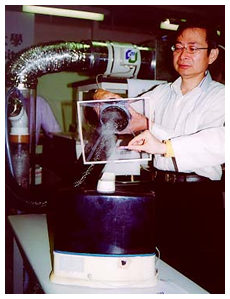
In addition to research on sewage and ventilation systems, the Building and Construction Department earlier announced the development of a virus cleaner system to prevent cross infection in the intensive care units in hospitals, and a bacteria-killing device with ozone for use in indoor environments with heavy human traffic.
"We hope that our scientific study not only contributes to knowledge advancement, but also improves building design and minimizes the spread of deadly diseases," said Dr Yuen.