Nanofiber-based biodegradable millirobot that can release different drugs in targeted positions in the intestines
A nanofiber-based biodegradable millirobot, called “Fibot”, was successfully developed in research led by a scholar from City University of Hong Kong (CityU). Fibot can move in the intestines and degrade in response to the pH of its environment, thus releasing different drugs in different anchored positions. The research has shed light on the development of millirobots, with the potential application of the controlled release of drugs in targeted positions in the intestines. The research has also facilitated the development of biodegradable and adaptive devices with biomedical applications.
The research team was led by Dr Shen Yajing, Associate Professor in CityU’s Department of Biomedical Engineering (BME). Their findings were published in the academic journal Matter, under the title “Nanofiber-based biodegradable millirobot with controllable anchoring and adaptive stepwise release functions”.
Fibot can move and “anchor” in the intestines, driven by an external magnetic field
Targeted drug release at desired locations is difficult in the gastrointestinal tract owing to the acid/alkali environment of the stomach and intestines, as well as the rough surface of the gastric wall, and peristalsis of the intestine. However, Dr Shen and his team overcame all these obstacles.
“We named this nanofiber-based soft millirobot ‘Fibot’. It can be used for controllable anchoring and is fully degradable in response to the pH of its surrounding environment. Therefore, Fibot can release various drugs embedded in its body and legs step by step in the gastrointestinal tract,” said Dr Shen, as he introduced the team’s research achievements.
Dr Shen Yajing, from CityU, and his research team developed Fibot, a nanofiber-based biodegradable millirobot. Adjustments to its fabric materials allow Fibot to undergo controllable degradation in response to the pH of its surrounding environment and then release embedded drugs step by step at the “anchored” position. (DOI number: 10.1016/j.matt.2022.01.023)
“Anchoring” means Fibot can stay at a fixed position after being moved to the desired location inside the intestine, without being pushed away by peristalsis. Driven by an external magnetic field, the multi-legged Fibot can effectively move in the complicated environment of the gastrointestinal tract and “anchor” itself on the intestinal wall through the application of a strong magnetic field.
In vivo experiments in rabbits prove that Fibot can fully degrade in four hours
“Fibot’s legs can penetrate intestine mucosa, which enables it to anchor at the desired intestine position without being pushed away by peristalsis. This is a prerequisite for drug release at a targeted position. Also, with precise control of the magnetic field, Fibot’s legs do not reach the submucosa and muscularis externa layers of the gastrointestinal tract, thus effectively avoiding the potential risk of bowel perforation,” Dr Shen explained.


The team conducted various experiments with Fibot. They found that driven by magnetic force, Fibot moved 7cm in 10 seconds in a pig’s stomach, which is rugged, wet and acidic, with a pH of 5. This demonstrated Fibot’s locomotive ability in the stomach.
The team also conducted an in vivo experiment in a rabbit’s intestine with Fibot. When Fibot moved to the targeted intestinal region, the team applied a stronger magnetic field to anchor it to the intestinal tissue. Fibot stayed there for four hours and eventually was fully degraded in that position.
Different pH-responsive degradation capability of the fabricated materials enables controllable drug release
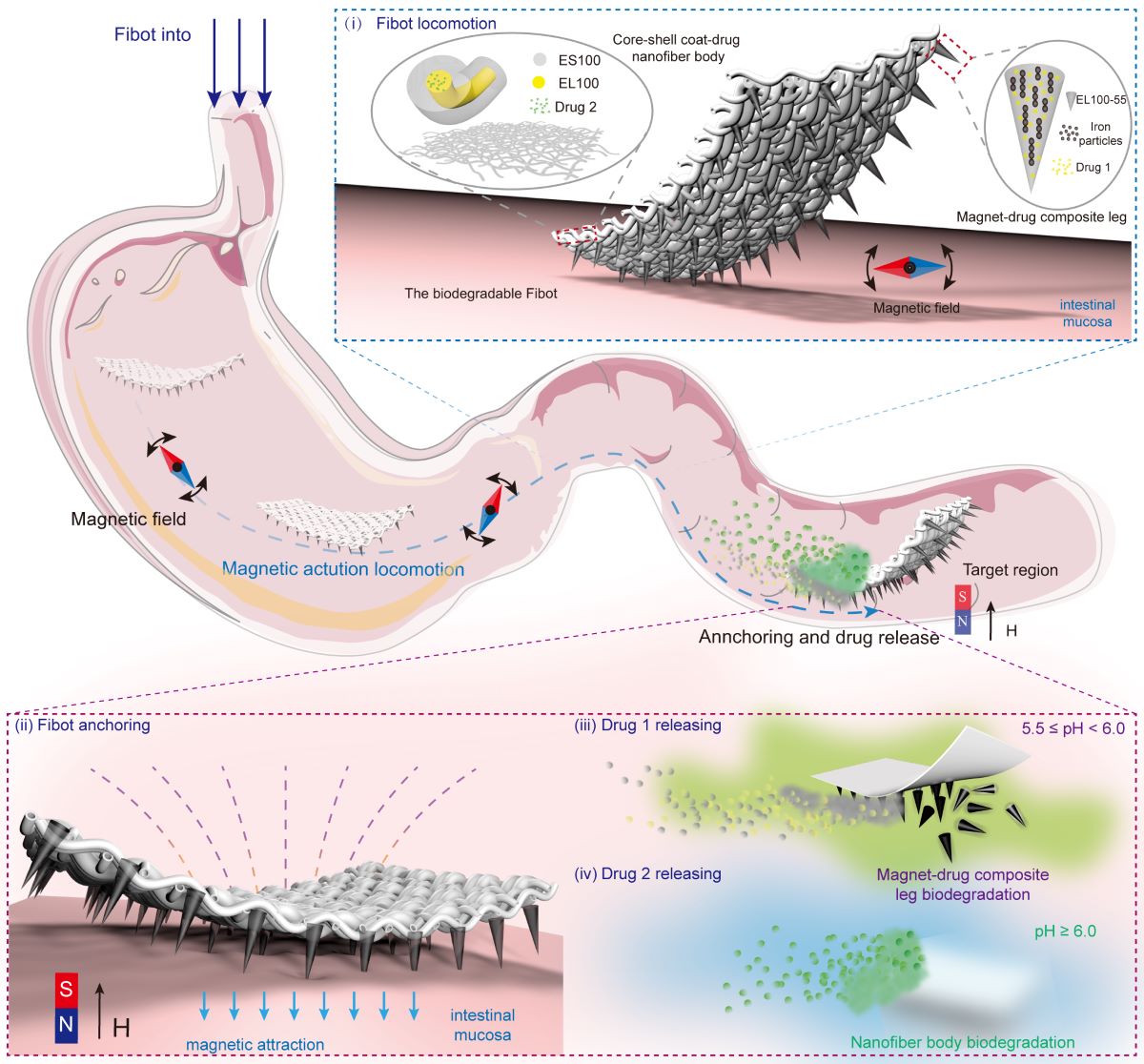
Another feature of Fibot is its capability to release different drugs.The key lies in the manufactured material. The team fabricated Fibot’s nanofiber-based soft membrane body and multi-legged array separately from biodegradable materials, and then assembled the two parts with a magnetic field-assisted electrospinning method.
The special core-shell structure of the nanofibers used in the body fabric enabled drug encapsulation within the shell. When fabricating the needle-like legs, the team adjusted the components of the material, and the drugs were placed inside.
“Since we adjusted the materials during fabrication, Fibot’s body and legs can degrade at different pH values, allowing us to control the gradual release of different drugs encapsulated in Fibot’s body and legs,” added Dr Shen.
Experiments show that in an acid environment like that in the stomach, where the pH is less than or equal to 5, Fibot’s structure remained stable and showed no leakage of the encapsulated drugs. When Fibot is located in an environment with a pH greater than or equal to 5.5, the body remains intact, but the legs dissolve slowly and release an embedded drug gradually over about 40 minutes. The remaining body can still be moved by magnetic force. In an environment with a pH greater than 6, the remaining body degrades fully within seven hours and releases another kind of drug encapsulated in the body.
Fibot is entirely biocompatible and safe for biomedical use
“In vivo experiments have proven that Fibot is entirely biocompatible and biodegradable, so it will not cause any intestinal obstruction. Anchoring it to the intestine tissue did not lead to any inflammation reaction, so we believe that Fibot is safe for biomedical use,” Dr Shen added.
Fibot sheds light on functional millirobot designs that are entirely biodegradable and can release drugs at an anchored position step by step. The findings have potential for use in future biomedical treatments, such as targeted region delivery and programmable release, and intestinal macromolecule delivery for clinical applications. “Fibot provides a new solution for localised therapy and has potential for macromolecular transdermal drug-release,” concluded Dr Shen.

Dr Shen is the corresponding author for the paper. The first authors are Tan Rong and Yang Xiong, PhD candidates from the BME. Other CityU researchers who participated in the research are Dr Lu Haojian, Yang Liu, Zhang Tieshan, Miao Jiaqi, and Feng Yu, who are PhD graduates and PhD students on Dr Shen’s team.
The research received funding support from the National Natural Science Foundation of China, the Shenzhen Key Basic Research Project, and the Hong Kong Research Grants Council.
DOI number: 10.1016/j.matt.2022.01.023