CityUHK and the Hong Kong Police Force unite to promote anti-scam awareness by hosting a series of seminars

City University of Hong Kong (CityUHK)’s Department of Media and Communication (COM) and Centre for Communication Research, in collaboration with the Chinese Academy of Governance (HK) Industrial and Commercial Professionals Alumni Association (CAGAHK), and the Good Home Good Man Association, co-hosted the “Anti-scam seminar series” on 21 February to promote anti-scam prevention messages and raise public awareness.
The first seminar, titled “Resisting technological crimes and preventing scam attacks”, featured Dr Frank Law Yuet-wing, Regional Commander of the Kowloon East Regional Headquarters of the Hong Kong Police Force. He shared insights on trends and cases of technology crimes and scams. Professor Liu Xiaofan, Assistant Professor in the COM, discussed how the University utilises big data and artificial intelligence (AI) technology to enhance anti-scam capabilities and public awareness, demonstrating the multi-faceted collaboration between the police, academia and the community.
Professor Michael Tse, Associate Vice-President (Innovation) and Director of the CityUHK Academy of Innovation (CAI), stressed in his opening remarks that anti-scam efforts require interdisciplinary cooperation, involving various aspects of the social sciences and psychology. CityUHK experts and scholars are delving deeply into these topics and are working closely with law enforcement agencies and telecommunications operators to actively promote anti-scam awareness.
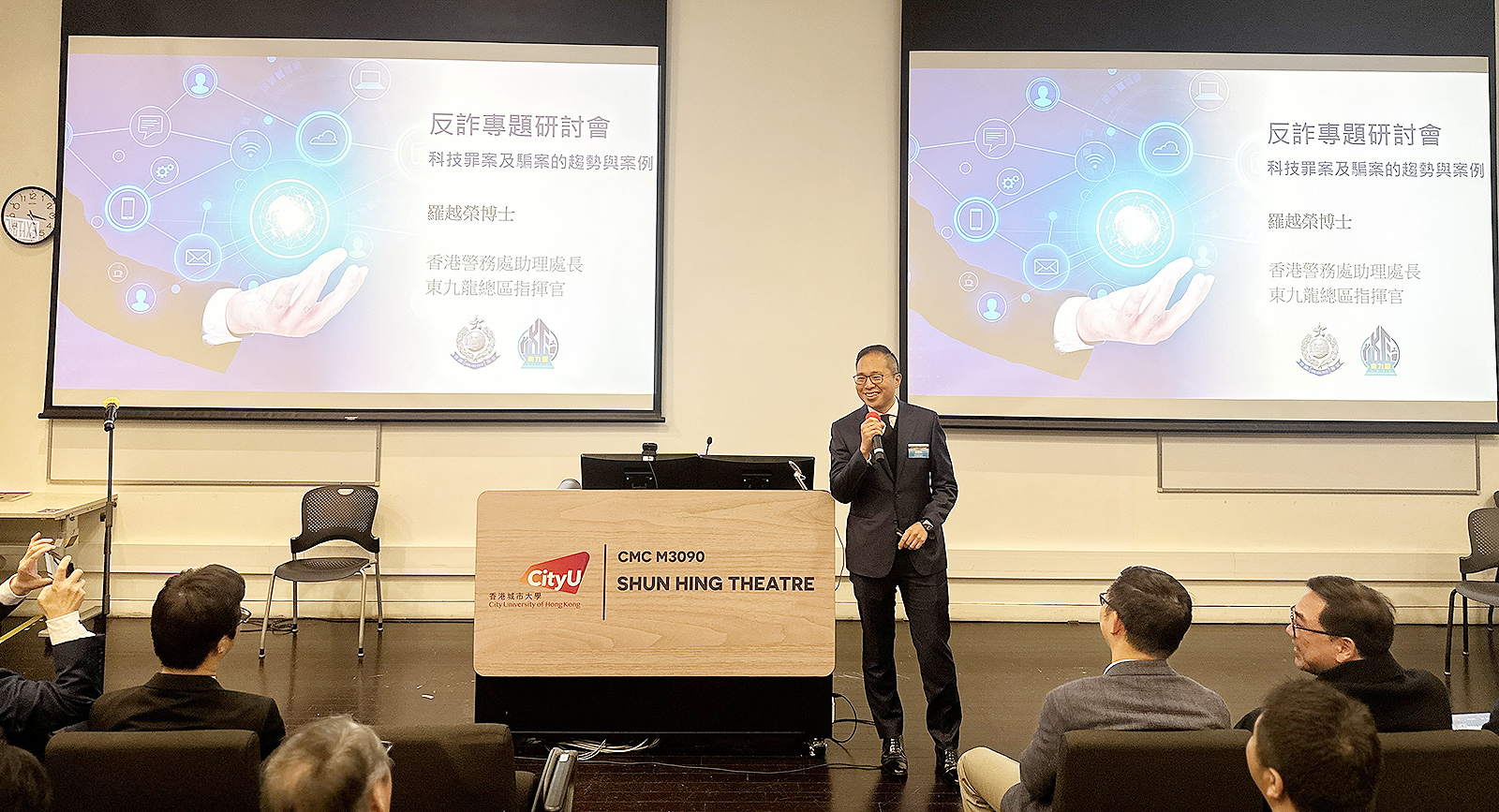
Dr Law stated that in the past year, scam cases in Hong Kong resulted in losses amounting to HK$9.1 billion, with average daily losses of HK$25 million and a scam occurring every 13 minutes, on average. He urged the public to make good use of the “Scameter+” mobile application to report suspicious phone calls, websites and bank accounts, in a collective effort to prevent scams.
Professor Christine Huang Yi-hui, Head and Chair Professor in the COM, emphasised that “communication” and “trust” are crucial in anti-scam efforts. The complexity and challenges of combating scams lie in the multi-party interactions involving the government, victims, and fraud groups. This involves not only the dissemination of information but also the establishment of persuasion, negotiation, coercion, and other multi-layered relationships, as well as long-term strategic interactions and tug of war. Moreover, fraudulent activities often involve new technologies and are accompanied by sustained manipulation. Therefore, anti-scam efforts must simultaneously build public trust in anti-scam agencies to ensure effective communication and sever the victims' trust in scammers to prevent them from falling into traps.

Professor Liu and a team of scholars in the COM have conducted in-depth research on scams for many years, analysing the characteristics of fake information dissemination from a psychological and behavioural perspective. He provides early warnings on new scam tactics and examines the psychological traits of both scammers and victims to develop effective publicity strategies and precise communication channels. His research aids in identifying potentially fraudulent activities, intercepting scams in real time, and constructing post-incident evidence chains to establish a shared data platform.
Professor Liu noted that the trend of customer service impersonation scams mentioned by Dr Law aligns with CityUHK’s real-time monitoring data. “Many people believe that ‘Gang Piao’ (those who leave their place of birth and choose to work in Hong Kong after graduation) and the elderly are more easily deceived,” he emphasised. “But in fact, anyone can be targeted by scammers at some point in their life.” Therefore, the public needs to stay informed about the latest scamming techniques and heighten their awareness of how to identify scams and protect themselves.
CityUHK has maintained a close collaboration with the police. The University set up an interdepartmental task force to closely monitor scam-related issues. To further enhance students’ scam awareness, CityUHK requires all students to complete an anti-scam questionnaire, co-designed with the police, in the new 2025 semester. Additionally, the task force uses various channels, including sending emails, posting on-campus posters and distributing flyers, to remind students to be vigilant about fraudulent information. Furthermore, CityUHK is collaborating with telecommunications companies both locally and in mainland China to use AI technology to intercept suspicious calls.
This seminar aims to raise public awareness of tech crimes and scams and explore how advanced technology can be used to prevent fraudulent activities. CityUHK will continue to work hand in hand with various sectors to combat scams and protect the interests of students and other members of the public.