Autistic pupils benefit from innovative virtual reality programme
Cathy Lau

????????????????????????????????????????????????
A virtual reality (VR) based training programme developed by a multi-disciplinary team led by City University of Hong Kong (CityU) enhances the social adaption and emotional skills for school-aged children with Autism Spectrum Disorder (ASD), according to a recent study.
The pioneering VR based training programme for social adaptive and emotional training (vPAD), helps children with ASD to respond appropriately and adapt to a range of different social environments.
An assessment involving 125 children diagnosed with ASD showed that those who have received vPAD training scored higher on social interaction and emotion expression, and showed improvement in emotion recognition.
The children, from 17 local schools in Hong Kong and aged between 6 and 12, were divided into two groups. One was treated as a control group and the other received vPAD training. Results showed that there was a statistically significant difference in the assessment scores between the training and the control groups on affective expression and social interaction.
Upon in-class observation, children from the training group showed significant improvements in related activities and were able to reflect their understanding through interaction with classmates. The children were able to take note of changes in their classmates’ facial expression and understand their emotions.
In addition, they were more able to express their emotions appropriately, initiate social contact such as greetings, and sustain conversations.
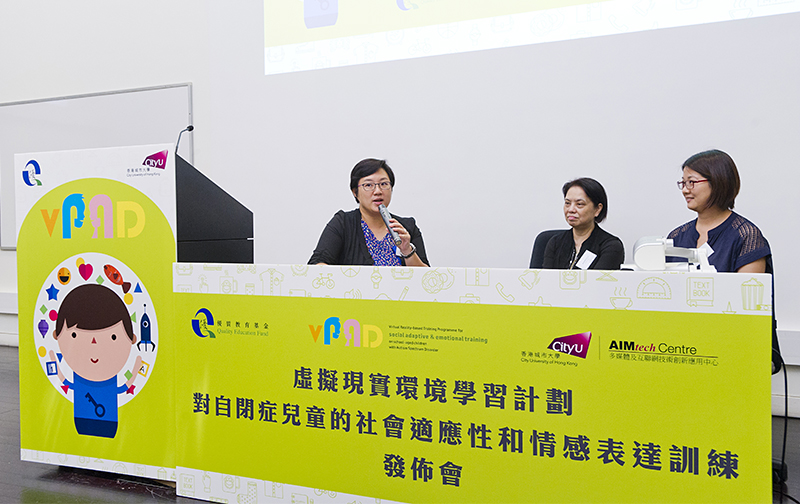
The project, funded by the Government’s Quality Education Fund, was led by Professor Horace Ip Ho-shing, Vice-President (Student Affairs) and Director of the Centre for Innovative Applications of Internet and Multimedia Technologies (AIMtech Centre) at CityU.
The project team includes medical and educational experts, and they are, respectively, Dr Dorothy Chan Fung-ying, Honorary Clinical Associate Professor from the Department of Paediatrics at the Faculty of Medicine of The Chinese University of Hong Kong, and Dr Simpson Wong Wai-lap, Assistant Professor from the Department of Psychology at The Education University of Hong Kong.
Professor Ip said that deficits in social-emotional reciprocity, which is one of the diagnostic criteria of ASD, severely hindered children with ASD from responding appropriately and adapting to different social situations.
In response to this problem, the team has designed six unique learning scenarios for school-age students with ASD. These immersive learning scenarios were enabled by multi-projection VR technologies that provided an authentic, immersive, situated, safe and controllable educational environment.
One scenario focuses on relaxation strategies, four simulate social situations, and one facilitates consolidation and generalisation. The scenarios have been designed and developed together with the corresponding psychoeducation procedures and training programmes.
“We hope that through the VR training programme, autistic pupils can learn social communication and social interaction skills across different contexts, and transfer the skills they have learned to their classrooms,” said Professor Ip.
vPAD has been developed using AIMtech Centre’s vast experience and innovations in virtual reality technologies with applications in creative arts, education, and psychotherapy.
Examples of AIMtech Centre’s innovations in virtual reality include Smart Ambience Therapy (SAT), a virtual environment for psychotherapy involving physically and/or psychologically abused children; Smart Ambience for Affective Learning (SAMAL), a smart classroom for affective learning; and Interactive Sensory Programme for Affective Learning (InSPAL), a VR-enabled learning environment and training programme designed specifically for the learning needs of students with severe intellectual disabilities (SID).????????

??