Ultralight antenna for 5G networks receives $11m in mainland funding
Terry Lam
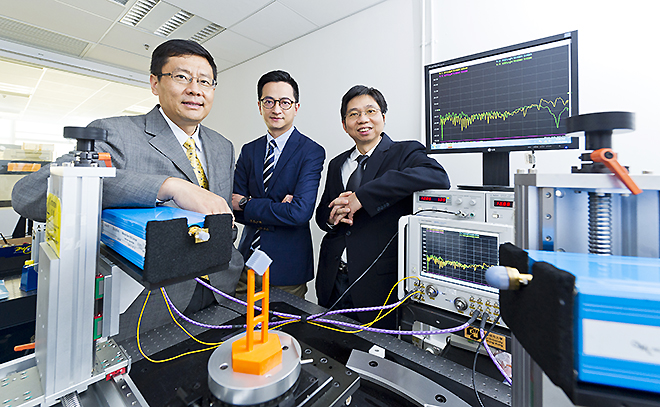
A research project has been granted worth more than HK$11 million from the National Science and Technology Major Project funded by the Ministry of Industry and Information Technology for ultralight, small antennas developed by the Department of Electronic Engineering (EE) and State Key Laboratory of Millimeter Waves (SKLMW) at City University of Hong Kong (CityU).
The new antenna’s weight and size are reduced by as much as 50% and will bring about a brand new user experience for the forthcoming 5th generation (5G) mobile networks and beyond.
5G planning aims for more mobile broadband users per area unit and consumption with a higher or unlimited gigabyte data capacity per month. 5G can support more diversified big data applications such as sophisticated health monitoring and fascinating live photos.
To accomplish this, a huge number of antenna elements will be required for the future 5G base station antenna to enable the high-speed massive multiple-input and multiple-output (MIMO) network. However, this will cause various problems including overloading on building roofs, expensive set-up costs due to the larger area for installation, and difficulties in daily maintenance of the networks.
The principal investigator Dr Wong Hang, Assistant Professor of EE and a member of SKLMW, together with Professor Leung Kwok-wa, Chair Professor of EE and a member of SKLMW, and Professor Xue Quan, Chair Professor of EE and Deputy Director of SKLMW, have rich experience in the development of highly efficient antenna. The team has successfully come up with innovative solutions for the above constraints.
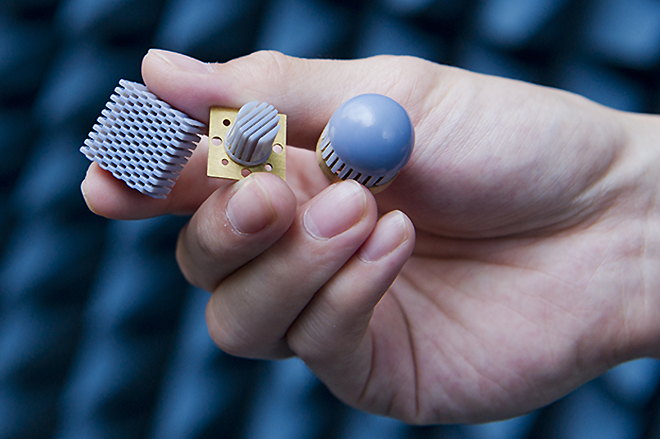
“The key to this project is to minimise the weight and the size of the antennas. By using novel technology in material science and 3D printing, our new antenna design is 50% reduced in weight and 30 to 50% smaller,” Dr Wong said.
Instead of using metal as with traditional antennas, plastic polymers with excellent electrical characteristics have been identified for this project. Furthermore, the polymers can be 3D-printed into the desirable shape and size, making the antenna ultralight and compact.
The project titled “TD-LTE Small Dielectric-Resonator Base Station Antennas Development and Industrialization” commenced in 2015 and will be completed in 2017. This timeline matches perfectly with the 5G implementation timetable. The first worldwide trial for this next generation network will be carried out in 2018, with the official demonstration set for 2020 during the Tokyo Olympic Games.
The research is a joint effort with telecommunications professionals and researchers from Comba Telecom Systems (Guangzhou) Ltd., Jiangsu Jiangjia Electronic Co., Ltd., and Beijing University of Posts and Telecommunications.