CityU’s new technology turns air pollutants into harmless substances
Christina Wu, Joan Yip
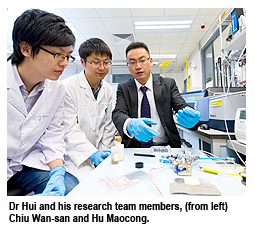
A novel air purification technology developed by Dr Oscar Hui Kwan-san, Lecturer from the Department of Systems Engineering and Engineering Management at City University of Hong Kong (CityU), transforms air pollutants such as formaldehyde and toluene into harmless substances.

In an ordinary indoor environment, over 100 different compounds can be classified as volatile organic compounds (VOCs), including formaldehyde and toluene. VOCs may cause cancer or seriously damage the brain.
Dr Hui found that VOCs transform into water and carbon dioxide after flowing through and reacting with nano materials coated with catalysts and ozone, a process called ozone catalytic oxidation (OCO). Copper oxide, cobalt oxide and manganese oxide are three of the catalysts used in the process.
Dr Hui’s research team recently received a grant worth HK$1 million from the Innovation and Technology Fund launched by the government to develop a highly efficient air purifier that is low on energy consumption. His team also received HK$200,000 from two private firms to develop a decomposition-based air cleaner prototype.

The air purifier developed by Dr Hui can remove 92% of the VOCs in the atmosphere, of which 65% is transformed into water and carbon dioxide, and the rest adsorbed by the filter. At present, home-use air cleaners adsorb VOCs through a filter, but cannot break down VOCs into earth-friendly substances. The carbon dioxide generated by ozone catalytic oxidation will not affect air quality.
Dr Hui will conduct further tests on the nano materials to select a highly efficient material that can be loaded with active and stable catalysts. He will also look for a combination that results in the fastest reaction time so as to enhance the percentage of VOCs transformed into harmless materials.
The air purifier also possesses an energy-saving sensor that turns the device on and off according to the concentration of VOCs in the vicinity.
VOCS can be released into the atmosphere from construction materials, carpets, furniture, laser printers, copiers, as well as chemical products such as cleaning products, adhesives and paint.