CityU releases the words most commonly used and marginalized from 1997 to 2007
Catherine Ng
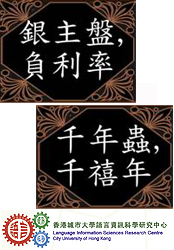
“Since 1997, Hong Kong and mainland China have become closer in political, economic and cultural terms,” said Professor (Chair) Benjamin T’sou Ka-yin, Director of the Language Information Sciences Research Centre.
“During this period, many words from the mainland and other Chinese speech communities have been imported into Hong Kong, and at the same time many new words have been created in Hong Kong. With the 10th anniversary of the handover approaching, this is an ideal opportunity to review some of the more salient Chinese words and the stories behind them,” he said.
Examples of new words include ‘特首 (Chief Executive)’ and ‘特區 (Hong Kong SAR)’, while phrases such as ‘千年蟲 (millennium bug)’ are used less frequently.
The Centre has processed over 200 million Chinese characters since 1995 using a unique synchronous corpus known as LIVAC. This corpus rigorously processes media text materials from several major Chinese speech communities, including Hong Kong, Macau, Beijing, Taiwan, Shanghai and Singapore. The data can be used for longitudinal studies of the linguistic characteristics of Chinese used in different speech communities around the world.
According to LIVAC, approximately 10,000 new Chinese words have emerged in Hong Kong in the last decade. Some have originated from mainland China, such as ‘黃金周(Golden Week)’, ‘自由行(individual visit)’; others stem from Taiwan, such as ‘第一家庭(The First Family)’, and ‘紅衫軍(the red shirted army)’.
“In addition to looking at the single cumulative frequencies of new words over the past decade, it is important to take into account the dynamic development of these frequencies,” Professor T’sou said.
“The occurrences of these words in the media have changed according to the currency of concepts or events they represent. Therefore, while these words reflect events that have been of concern to people in Hong Kong, they also provide interesting reflections upon Hong Kong culture.”
The new words identified by LIVAC can be divided into four major categories:
- Stabilized new words (常用詞): These words are frequently used and have become common words in Hong Kong. Examples include ‘紅籌 (red chips)’, ‘泛民主派 (pan-democratic alliance)’;
- Quasi-stabilized new words (準常用詞): The frequencies of these words have increased over time and will quite likely become common words in the future. Examples include ‘強政勵治 (strong governance for the people)’, ‘香薰 (aromatherapy)’;
- Quasi-marginalized new words (準邊緣詞): These words were used frequently in the past, but they seem to be in decline. Examples include ‘負資產 (negative equity)’and ‘法輪功 (Falun Gong)’;
- Marginalized new words (邊緣詞): These words have been marginalized and are fading from usage, if not memory. Examples include ‘千年蟲 (millennium bug)’ and ‘清潔大隊長 (leader of the cleansing brigade)’.