FB's PDAs boost interactive learning
Audrey Chung
In support of the University’s drive to enhance teaching and learning through technology, the Faculty of Business (FB) held a seminar entitled “Interactive Learning with PDAs: Strategies, Implementation and Results” on 28 March to share its experience using wireless PDA technology to boost interactive learning in large classes with heads and teachers of other faculties and schools. Participants also had a chance to try out the interactivity of the PDA technology during the seminar.
CityU is committed to providing a technologically advanced environment that maximizes students’ learning. FB’s PDA project is an example of CityU’s initiative in exploring teaching innovations to facilitate two-way communication in the classroom.

At the seminar, Professor Christian Wagner, Director of FB’s First Year Teaching and Learning, said the PDA project was part of an initiative to give students personalized instruction and an integrative learning experience.
“With the PDA, students in large classes can answer the instructor’s questions and the instructor can give instant feedback,” Professor Wagner said. “In addition, the PDA project is useful for co-curricular activities since students can browse websites and download instructional materials out of the classroom.”
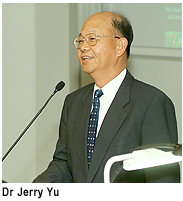
Other speakers at the seminar included Professor L K Chan, Dean of FB; Professor K K Lai, Associate Dean (Undergraduate programmes) of FB; Dr Jerry Yu, Chief Information Officer; and Professor (Chair) Douglas Vogel of the Department of Information Systems (IS).
In his speech on IT in education, Dr Yu said CityU was encouraging students to use IT on a daily basis, thereby enhancing their learning, and the PDA project
Initially launched as a pilot run in IS in the first semester of the 2004-05 academic year, the PDA project aims to make large classes more interactive by giving students instant feedback, and enable instructors to adjust the pace of the course to achieve quality teaching. The PDA project was introduced to the whole of the Year 1 cohort of Bachelor of Business Administration students and all departments in FB in the second semester of the 2004-05 academic year.
To date, with the project approaching its third year, 30 members of the FB teaching staff have used PDAs with up to 200 students. About 2,000 students are participating in the project, using PDAs with a growing set of interactive applications to foster student-centred learning and better measurement of desired learning outcomes.
The interactive learning applications, a new element added to the project starting in 2005-06 include crossword puzzles, open ended-questions and multiple-choice questions.
Dr Ron Kwok, an assistant professor in IS who came up with the idea of introducing mobile exercises targeting students’ out-of-class learning, said: “We
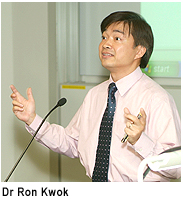
Looking forward to providing more activities to enhance students’ learning, Dr Kwok said that “e-movies”, which refer to movies shot during lectures, will help students revisit course materials in their spare time, for example, in the canteen or on the bus and MTR.
Dr Christina Sue-Chan, an assistant professor in the Department of Management, has been involved in the PDA project since it was first introduced. Dr Sue-Chan said the major benefit of PDAs in large classes was to take away the shyness factor from students.
“When I ask questions on PDAs, virtually everyone responds,” Dr Sue-Chan said. “Their responses, in turn, give me feedback on what they understand and
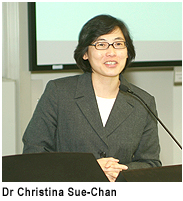
According to Dr Sue-Chan, the PDAs have helped instructors and lecturers gain immediate feedback on whether intended learning outcomes have been achieved. They also permit students to receive immediate feedback on how well they are performing in the course without having to wait until the mid-point or end of the course.