From
Hollywood to Bollywood and Steven Spielberg to Zhang Yimou, three distinguished speakers and some 50 guests engaged in a thought-provoking conversation on the movie and television industry in
Asia at the City Cultural Salon moderated by CityU President
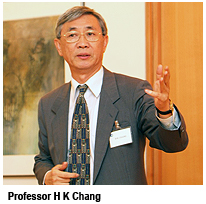
Professor H K Chang on 23 June. The discussions focused on the future of the
Hong Kong movie industry given the booming creative media industries on the Mainland and in
India and
South Korea, and how creative media will shape the experience of watching movies in the ultra hi-tech and fast-moving world of tomorrow.
The City Cultural Salon was started seven years ago by Professor Chang, the Chairman of Culture and Heritage Commission in
Hong Kong from 2000 to 2003, as an outreach activity aimed at raising the profile of CityU as a force in
Hong Kong’s cultural scene by providing a forum for people in the arts and culture arenas. To date, the Salon has attracted more than 2,000 participants in its almost 70 gatherings.
The 23 June discussions, which attracted the largest number of guests and speakers so far, were tied closely to Professor Chang’s efforts in promoting creative media education in Hong Kong. He conceived the idea of establishing a School of Creative Media (SCM) in 1997, with an aim to train multimedia professionals to integrate theory and practice, arts and technology, aware that Hong Kong was transforming into a knowledge-based economy and the media and entertainment industries were relying more and more on advanced computer and telecommunication technologies to deliver their products.
Of the three invited speakers,
Mr William Pfeiffer, Chief Executive Officer of the Hong Kong-based Celestial Pictures Ltd, is noted his for philosophy “think globally, script locally”. Set up in 2000, Celestial Pictures owns the largest Chinese film library in
Asia—the Shaw Brothers’ films—and distributes them to studios worldwide. Mr Pfeiffer, a
Stanford University graduate who changed careers from a pharmaceutical marketing person to a media executive, is regarded as a pioneer in the globalization of the Asian film media.
Ms Barbara Robinson, Managing Director of Columbia Pictures Film Production Asia (CPFPA), is well-known for her pioneering efforts in launching the movies of China’s fifth generation film-makers such as Zhang Yimou’s Not One Less in the international marketplace. CPFPA also co-produced Ang Lee’s Oscar award-winning Crouching Tiger, Hidden Dragon. Stephen Chow’s box office smash Kung Fu Hustle is among the company’s latest successes globalizing Asian production. Ms Robinson started her career as a teacher at Tsinghua University in Beijing, and then worked her way to the film business when she moved to Taiwan in 1986.
Professor James Moy, Dean of CityU’s SCM, is a noted academic in theatre, film and performing arts. He was the Dean of the College of Fine Arts and Professor of Theatre and Dance at the
University of New Mexico prior to joining CityU in September 2004. Professor Moy is the author of two books:
Marginal Sights: Staging the Chinese in America and
Reviewing Asian America: locating diversity. He is fascinated by the convergence of Western and Chinese cultures in
Hong Kong and has chosen the SCM as his frontier for nurturing Asian talents for the global media.
With 2005 being the 100th anniversary of film industry in China, the speakers started with a review of the film industry on the mainland. They saw the future of the film industry in Hong Kong increasingly tied to its booming counterpart on the mainland. “A huge market like China justifies investment and production the scale like Crouching Tiger, Hidden Dragon,” said Mr Pffeifer. Experimenting with commercialization, westernization and globalization, the mainland film industry has a lot of opportunities for collaboration and co-production with its Hong Kong counterpart.
“It is amazing,” said Ms Robinson, referring to the development of film industry in China in the past 20 years, but she added that although China’s film industry was filled with creative and talented individuals with financing and production know-how, it still had plenty of room for development, a process in which Hong Kong could play a major role. “The future of Hong Kong film industry will be a generation of co-production with the mainland,” Professor Moy said.
He added his perspective on the new generation of media professionals. “The future belongs to the nomads, people who move fast with new technology. Agrarians, the group of people who settle with a niche, will be wiped out.” As SCM Dean, he sees the importance of keeping students at the edge of new technology. “They must be able to learn and apply what they learn fast,” he stressed.
As to the booming movie industry in India, known as “Bollywood”, both Mr Pfeiffer and Ms Robinson see it as a positive sign of cultural diversity, rather than as a threat to movie industries in China and Hong Kong. Movies in China and India have different strengths. To Mr Pfeiffer, Indian movies are characterized with songs, dances and musicals, while movies in Hong Kong are strong in action, kung fu and visuals. The strong visual landscape in Chinese movies, such as the striking colours of China’s Northwestern provinces presented by those fifth generation film makers, appeal to Western audiences in different ways to that of the Indian movies. In fact, the real issue threatening the movie industries in both Hong Kong and China is the problem of piracy, not competition from other Asian countries, according to the speakers.
Rounding up the discussion, Professor Chang asked the speakers: What do the words “creative media” mean to you? Mr Pffeifer responded with ultra hi-tech images of interactivity and communication of a virtual world. “People as social creatures crave interaction and community,” he said. “Creative media in the future will get people to interact with each other, perhaps through button and voice activation.”
Despite its relative youth, the SCM, formally established in 1998, has already nurtured a number of talented professionals for the media industry, from film and television production to computer animation and web design. In addition, in view of the importance of internationalization, SCM established the Trilateral Partnership with the Beijing Film Academy and School of Cinema-Television of University of Southern California in July 2004 to promote academic exchange and deep collaboration with world-class institutions.