百家乐怎么玩-澳门百家乐官网娱乐城网址_网上百家乐是不是真的_全讯网888 (中国)·官方网站

Environmentally-friendly dimmable technology reduces energy consumption

Regina Lau


CityU researchers have developed a novel dimmable lighting technology that has the potential to reduce at least 1 % of global electricity consumption. The technology has been successfully applied in a number of outdoor lighting systems on the mainland. Field trials have shown that it has the capability of reducing energy consumption up to 30% in lighting system.  Reduced electricity consumption leads to reduced carbon dioxide emission, which, in turn, helps relieve global warming.


At a press conference on 18 April, Professor Ron Hui and Dr Henry Chung of CityU’s Department of Electronic Engineering demonstrated how the dimmable technology works in lamps and how it contributes to the reduction of environmental pollution. Both Professor Hui and Dr Chung pointed out that, in lighting systems, having dimming ability does not necessarily mean energy-saving, and energy-saving technology does not necessarily mean that it is environmentally-friendly. However, CityU’s novel dimmable lighting technology is both energy-saving and environmentally-friendly.
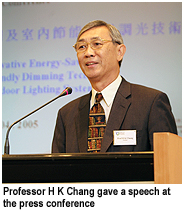
 

“Striking a balance between development and harmony of the ecosystem has become an issue of common concern for mankind,” said CityU President Professor H K Chang while kicking off the press conference. “The novel dimmable technology introduced by Professor Hui and Dr Chung not only reduce energy consumption, it also helps reduce damages to the ecosystem.”


In electric lighting systems for discharge lamps such as fluorescent lamps and high-intensity-discharge lamps, a device known as “ballast” is used to control and limit the current in the lamp. The mainstream product, “electromagnetic ballast”, consists of a choke which is made of metal core and copper winding. It is highly reliable and has a typical lifetime of 15-20 years, with little maintenance required. The metallic choke is recyclable and is therefore environmentally friendly.


There is a recent trend of replacing the “electromagnetic ballasts” with “electronic ballasts”, because the latter consume about 10 to 15% less electricity. However, the increasing use of energy-saving electronic ballasts leads to an environmental problem – accumulation of toxic electronic waste. Electronic ballasts have a relatively short lifetime ranging from one to five years. Each piece of electronic ballast can only control up to one to three lamps. Therefore, widespread use of electronic ballasts will lead to massive accumulation of toxic electronic waste.


Professor Hui and Dr Chung developed a central dimming technology that can turn “non-dimmable” electromagnetic ballasts into “dimmable” ones. It is compatible with all electromagnetic ballasts and no major rewiring is required. Its dimming capability allows users to use lighting energy when and where it is necessary and to the appropriate lighting level.  Each central dimming system can control up to 150-200 discharge lamps, so substantial reduction in electronic waste can be achieved.  It has a “self-recovery” feature, that is, if the central dimming system fails, the lighting system will continue to work. “The novel technology is suitable for extreme weather conditions and requires very low maintenance cost,” said Professor Hui.


Through the support of a CityU associated company, e. Energy Technology, this central dimming technology (patent-pending) has been successfully applied to road lighting systems. It is suitable for applications both in indoor and outdoor  large lighting systems such as roads and highways, parks and gardens, multi-storey car parks, public housing estates, industrial and commercial buildings, airports, hotels, universities and sports stadiums.


Lighting systems consume about 15 to 18% of global electricity. If the new technology is widely applied, it could reduce power consumption in electric lighting systems by 1/15 (or 6.7% in the lighting energy sector), thus reducing 1% of global electrical energy consumption annually. The central dimming control system has been tested in China since September 2004, registering an average electricity saving of 30%. “Not only can this technology reduce power consumption and pollution in China, it can be exported as a global technology from China,” said Dr Chung. It is now being installed in a mainland city, Heshan in Guangdong province, for controlling over 7000 street lamps.


YOU MAY BE INTERESTED

Contact Information

Communications and Institutional Research Office

Back to top
足球怎么赌| 爱婴百家乐官网的玩法技巧和规则 | 百家乐英皇娱乐网| 百家乐官网游戏大厅下| 澳门百家乐官网技巧经| bet365维护| 郑州水果机遥控器| 百家乐如何打轮盘| 百家乐赌博软件下载| 宝龙百家乐娱乐城| 百家乐官网策略网络游戏信誉怎么样| 百家乐官网赌博策略| 百家乐官网公式书| 六枝特区| 泰来县| 百家乐官网色子玩法| 澳门百家乐官网出千| 丰台区| 鼎丰娱乐城开户| 张掖市| 聊城市| 巩留县| 百家乐官网游戏机博彩正网| 百家乐官网开发软件| 网上百家乐官网是真是假天涯论坛| 百家乐官网开户过的路纸| 百家乐官网园天将| 如何玩百家乐扑克| 百家乐官网桌子租| 百家乐在线投注顺势法| 百家乐b28博你发v| 大发888娱乐城游戏lm0| 战神国际| 万豪国际娱乐| 太阳城百家乐官网下载网址| 太阳城金旭园| 大发888娱乐游戏注册| 博必发百家乐的玩法技巧和规则| 全讯网直播| 石门县| 百家乐官网三珠连跳打法|