Does one established culture tend to repel the influx of a different culture? The spread of Buddhism into
China,
Japan,
Korea and
Vietnam seems to demonstrate that different cultures interweave and complement each other.
Professor Xu Jialu, Vice-Chairman of the 10th Standing Committee of the
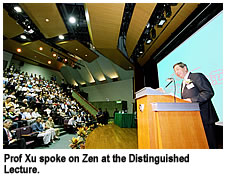
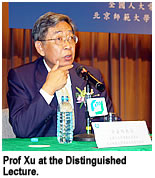
National People’s Congress and renowned linguist, shared his insight on the compatibility of cultures through a revisit of the spread of Buddhism with an audience of about 400 students and staff, in his Distinguished Lecture titled “Zen, an exemplar of the compatibility of China and foreign cultures” at the Wei Hing Theatre, 18 October.
Professor Xu, who is also Director of the College of Chinese Language and Culture of Beijing Normal University (BNU), graduated in 1959 with a degree in Chinese Literature from BNU's Department of Chinese Literature. An expert in exegesis and the
study of the meaning of the languages of the past, Professor Xu chose to speak on Zen from an observer's perspective. “Religion was a difficult topic,” he said, “but throughout my years of study of Chinese languages and culture, I realized that knowledge of Buddhist teachings, and Buddhism's development and spread is important to my understanding of the meaning of languages and culture.”
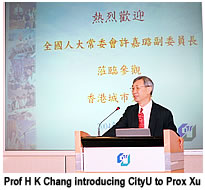
“We are grateful to Professor Xu for sparing time to share his insights on Buddhism with us,” said Professor H K Chang, CityU President. “His enthusiasm in pursuing knowledge of spiritual topics like Buddhism reflects his serious attitude towards knowledge acquisition.”
The inspiration of Buddhism
In his lecture, Professor Xu recapped the major doctrines of Buddhism, and how it spread to
China from
India in the late Han dynasty. “The convergence of cultures involves three stages: introduction, digestion and absorption,” Professor Xu explained. When Buddhism was first introduced to
China, it was regarded as supernatural. Nonetheless, it proceeded to the 'digestion' stage when monks began the massive translation of the Buddhist canon in the Northern and Southern dynasties, which also marked the fusion of Chinese and Indian cultures. Buddhism underwent further digestion and absorption as it interweaved with Chinese Taoism and Confucianism in the Xu and Tang dynasties and eventually evolved into Zen.
During the expansion of Buddhism, the differences and similarities among cultures were acknowledged. "Each culture needs nourishment from another culture," Professor Xu said. “A reluctance to accept differences hampers the advancement of culture and leads to decay... A time of peace is also critical to the successful convergence of different cultures,” Professor Xu observed. “Peace facilitates the development of multi-culturalism.” Buddhism spread from India to China, Japan, Korea and Vietnam without bloodshed.
To absorb a different culture, Professor Xu asserted, it must become part of oneself. The transformation has to begin from the outermost layer, that is, the physical and material aspects of life, such as food and clothing. Literature, arts, etiquette, law, policies and religions comprise the middle layer of culture, while values contribute to the innermost layer.
It takes time for cultures to converge and merge. While it took 600 to 700 years for Zen to spread into China, the rise of the Southern School of Zen as the dominant religion took almost a thousand years. Support from the ruling class and the intellectuals was also critical to the spread of Buddhism.
CityU has clear and unique positioning
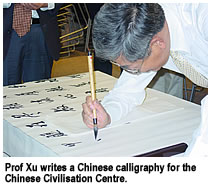
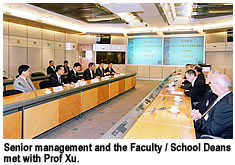
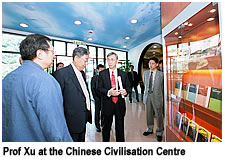
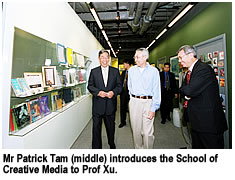
In addition to delivering his lecture, Professor Xu also met with the Senior Management and Faculty/School Deans, and toured the
Chinese Civilisation Centre, the
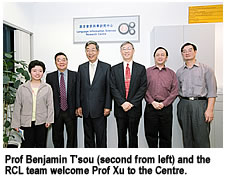
Language Information Sciences Research Centre and the
School of Creative Media. Professor Xu was impressed with the achievements of CityU despite its brief history and relatively small campus. He recognized the University’s wise deployment of resources and its efficient and advanced management systems. Professor Xu commended CityU’s vision in accurately positioning itself as a provider of professional education. “CityU has gained a unique position. The strengths of the University are well-matched with the needs of
Hong Kong,” he said. “Mainland universities could borrow from the CityU experience.”
Though technology-based, the University places great emphasis on fostering international collaboration and promotion of Chinese culture. Professor Xu praised CityU’s efforts and success in utilizing technology for teaching Chinese culture. He remarked that cultural literacy is a key to the nurturing of talented people and he urges university students to pursue cultural studies. Professor Xu hopes that more mainland universities will come to CityU to learn from the Chinese Civilisation Centre's example.
CityU as a convergent point of cultures
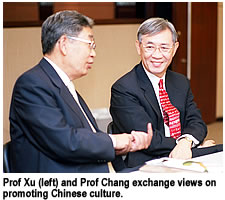
Professor Xu also shared Professor H K Chang’s view that CityU serves society beyond
Hong Kong's borders. “CityU and
Hong Kong should develop into the education hub of south
China and foster links with mainland and overseas partners,” Professor Chang said. Professor Xu was glad to learn of Professor Chang's promotion of trilateral alliance and that it is being realized via, for example, the trilateral partnership among the
Beijing Film Academy, the
University of Southern California and CityU.
No substitute for Hong Kong’s role as a point of convergence between Chinese and foreign cultures exists in any city on the mainland, Professor Xu suggested.
Hong Kong receives foreign cultures and then passes it in a modified form to the mainland. This also describes the position of CityU which possesses an international faculty each member of which brings their own cultural elements to the campus.
Professor Xu said that Chinese and foreign cultures converge either linearly or at specific points. The Silk Road is an example of how Chinese and foreign cultures converged linearly, while the monks who translated the Buddhist canon functioned as points through which the religion spread. The future development of China similarly relies on transmission through these points and lines. “Hong Kong will continue to play an important role in Asia and in the world," Professor Xu added, "as does CityU."
“Professor Xu’s remarks and advice to CityU are very encouraging,” Professor Chang responded. “We'll continue to do our best to live up to Professor Xu’s expectations.”
CityU will hold two more 20th anniversary Distinguished Lectures: one by Mr Xiao Yang, President and Chief Justice of the Supreme People’s Court of China; and another by Mr Orhan Pamuk, a renowned Turkish writer, on 12 and 25 November, respectively.