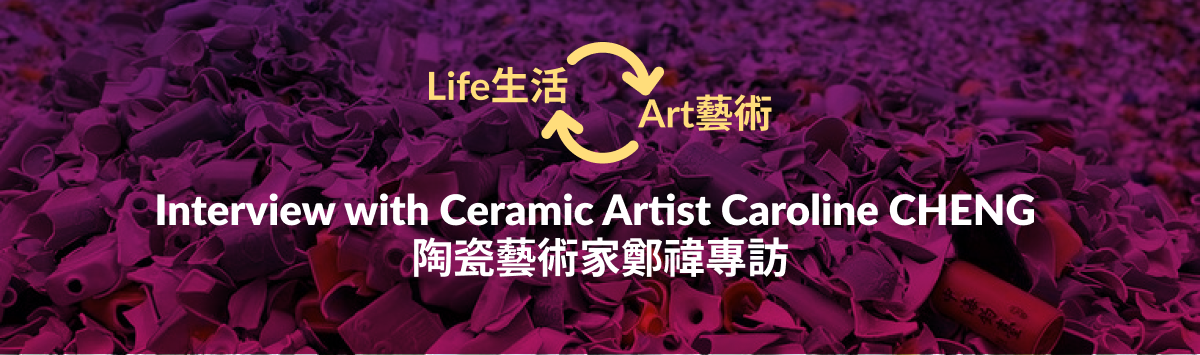
China produces 20 million tons of ceramic waste every year as a by-product of the industry. How to solve illegally processing such a large amount of non-biodegradable waste is imminent. The Cultural Exchange Oasis is honored to have Ms. Caroline CHENG, the co-founder of "Yi Design" shared with us how her team’s recycling technology converts ceramic waste into bricks, tiles, products, and even art experience in a Cultural Talk titled “We Start when They Finish”, and accepted our exclusive interview.

|
Q: Once aspired to become a veteran, why did you turn out to be a ceramic artist?
A: My grandfather CHENG Te-Kun was a professor at the Department of Chinese Archaeology at the University of Cambridge, and later served as the vice president of the Chinese University of Hong Kong. My grandmother was actively engaged in painting and pottery. After completing my master's program, I got an administrative position at an art center and also worked part-time in a bookstore. To increase income, besides selling books, I served at the bookstore café and learned about different types of coffee. When "The Pottery Workshop" was established, I set up and run a coffee shop successfully with my past experiences. Knowledge and experience are accumulated lifelong. Engagements at various stages might appear to be irrelevant and unconnected, but in fact, what you have gone through and obtained are valuable and could be very useful.
I am fond of animals since I was a child, and I still want to be a veteran. A year after I founded the zero-waste company "Yi Design", while writing a sustainable project report, I found that the relationship between humans, animals, and the environment is indispensable. I see that our commitment to regenerating ceramic waste is closely related to the conservation of organisms. |
Q: Growing up in a traditional Chinese family and receiving western higher education, what influence do Chinese and Western cultures have on you?
A: I remember when I was studying in secondary school in Hong Kong, a teacher often exclaimed that we are a generation without roots. I did not understand this comment at that time. Later, I studied and started a family abroad, and then went to the mainland to develop my career. Despite my friends jokingly describing my determination as "sheer bravery", I turned out to stay there for 22 years. Actually, Hong Kong people do not know much about China, like how many provinces and cities are there, and their life experiences towards the place are mostly narrow and one-sided. On the other hand, for those who have chosen to emigrate to the West are often unable to integrate due to language barriers. The phenomenon of resisting foreign cultures usually stems from a lack of understanding. How could it be an easy task to gain a deeper understanding of China, a country which has as many as 56 ethnic groups? I hope that the young generations can get to know the mainland by joining meaningful tours that can let them experience the life of local residents. Take my daughter as an example. She once participated to pour cement to build roads in the countryside, not only experiencing the hardships of peasant life and also teaching her how to help others and be grateful.


Q: Can you share with us the cultural elements in your ceramic works?
A: One of my masterpieces is a ceramic garment, which is composed of 35,000 handmade tiny butterflies, each containing nine parts. From a distance, the work got a prominent outlook and a strong oriental charm; from a close view, it is butterflies with ever-changing shapes, and the whole is unified while full of changes. Amid unavoidable damages caused by transportation, this added vitality and variability to the work. It is exactly like the rich and profound Chinese culture and things that you will never get tired of. In fact, I am proud of being a Chinese artist.
Q: Do you still work on ceramics? What are your future plans?
A: We will continue to conduct research and develop new recycling technologies. The purpose of returning to Hong Kong this time is to visit the Greater Bay Area, especially Foshan, a major town producing ceramics. I am trying to liaise with the local government to implement the "Yi Design" projects. We currently have got 5,000 tons of ceramic waste, and I have to find outlets for the transformed products. The amount we handled is insignificant compared to the millions of tons the country generates each year.
Art and life are complementary. In recent years, except for occasional demonstrations in class, I have ceased making ceramics. However, this does not mean that I do not work on art, because I believe that life is art, a simple act in everyday life can be creative.

