


Unveiling the Mystery of the Human Brain for AI Advancements
While machines can learn how to predict words, we have yet to understand how the human brain does it, and Dr LI Jixing’s research aims to uncover the secret
Li's research applies computational models to understand how the human brain represents and computes information during language comprehension.

Li aspires to find an exciting community of like-minded fellows in academia for a deeper understanding of the human-machine interface.
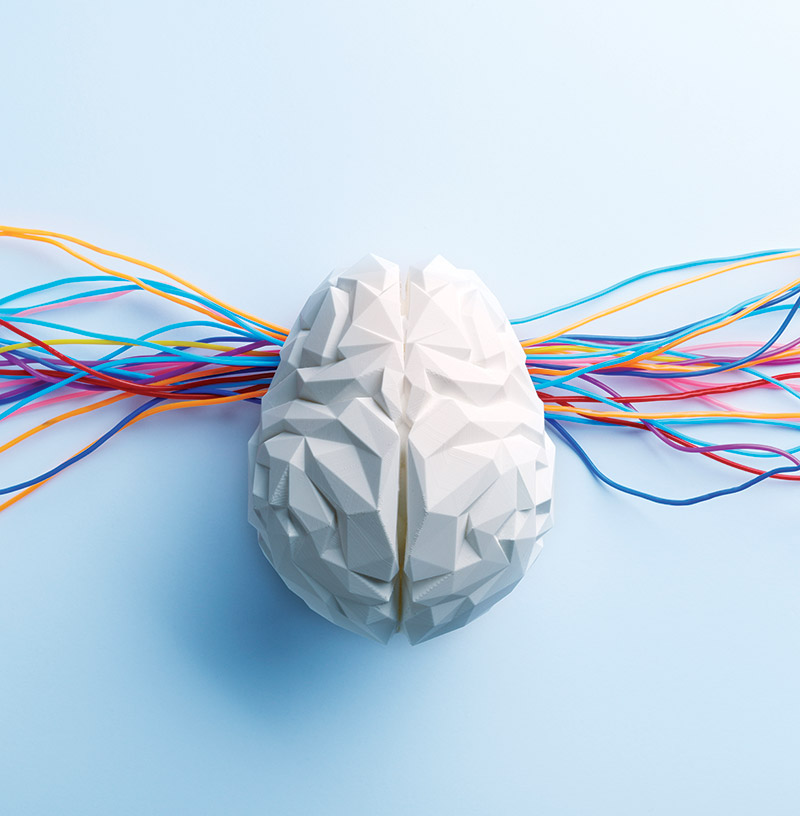
Li's research studies the ways in which humans predict words through comparisons with machine models.
Dr LI Jixing always imagined herself as a writer and that she would be doing something creative in languages one day. But little did she know that her creative journey would eventually lead her to the forefront of the world’s most cutting-edge research into computational neurolinguistics.
“When I began to realise that language is not an external object, but rather an internal object and a part of human cognition, I found that I was really interested in psychology, and this is where I developed a strong interest in psycholinguistics,” recounts the Assistant Professor at CityU’s Department of Linguistics and Translation and Assistant Professor (Affiliate) at the Department of Social and Behavioural Sciences.
Li kickstarted her educational career studying for her BA in English and Chinese at the Beijing Normal University. Then, with a newfound interest in language theories, she went to the UK to pursue her MA in Linguistics, from which she developed her strong interest in psycholinguistics. This eventually led her to complete a second master’s degree in Experimental Psychology at Oxford University and her PhD in Linguistics at Cornell.
At the time, her intention was to just focus on psycholinguistics, but her advisor, Professor John HALE, was a computational linguist by training and was also doing fMRI experiments. Inspired, she ended up in computational neurolinguistics and her research today applies computational models to understand how the human brain represents and computes information during language comprehension.
I want to promote the interdisciplinary study of cognitive neuroscience, language and computer science, to develop a scientific approach to linguistics
Dr Li Jixing
“I am so happy that Professor Hale got me into this field, especially at this time with all the developments in AI. People are interested in how we understand human cognition, and language is at the centre of that,” she says.
Indeed, Li has huge goals. Aside from getting tenured in the next five years, she is driven to bring her research team to the forefront of neurolinguistics studies in the world.
“I want to promote the interdisciplinary study of cognitive neuroscience, language and computer science, to develop a scientific approach to linguistics,” she says.
The Neural Mechanisms of Language Comprehension
As she begins to explain the nature of her work, it is easy to see why her research is critical in today’s tech-driven world. Humans are constantly predicting the next word when we hear speech. Citing an example, if we heard the sentence, “I spread the butter with socks”, the human brain would know that the word “socks” does not fit into the context. Li explains that the brain sends a strong signal around 400 milliseconds after we hear the word “socks”, and these neural signals can be measured using neuroimaging techniques such as EEGs, MEGs, ECoG, and fMRI.
She then explains that machines can also predict the likely next words. For example, when we input a keyword in search engines, Google finishes the sentence for us. In this respect, one of Li’s key research areas focuses on comparing these predictions for the next words using computational models and then comparing them with the neural signals to see if the models can inform us about the neural mechanisms of language comprehension.
“This is an exciting area in my research because we don’t know how humans predict words. We know how machines do it, so we can use a machine model to compare it to humans to learn how the human brain works. Neurons don’t do what machines do, but there might be some shared computational principles at a higher level,” she explains.
A Field with Growing Importance
Li has spent six years on this research, which is still in its infancy. “We still don’t know how to map linguistic theories to human neurobiology,” she explains. So, the key to solving this mapping problem is first to build the computational models that can quantify theories into testable predictions and then compare model predictions against human brain data.
But her research is not her only career goal. She also hopes to create a centre at CityU devoted to the interdisciplinary study of linguistics, natural language processing, and cognitive neuroscience.
For these reasons, CityU was her most obvious choice when she moved to Hong Kong.
“You have to find your community and surround yourself with like-minded people. They will get you excited about your research,” she says.
CityU is a reputed leader in interdisciplinary research. As “Brain” is one of the University’s five overarching research themes, Li feels right at home.
Indeed, CityU defines this field that Li is in as an interdisciplinary field that covers biology, neuroscience, medicine, psychology, computer science, and linguistics to study the human and computer brain for a deeper understanding of the potential of the human-machine interface.
In the world of modern technology and AI, Li believes this field is only going to become more important.
“Understanding languages is part of AI, and it’s important that machines understand us. Right now, people in AI approach this problem as an engineering process, so they train machines with texts from books and ask the machines to use these books to predict what people will say next,” she explains.
However, as humans, she said that we do not need books to be able to predict each other’s speech, so how do we do it?
“The brain is like a black box, and we don’t know how it works, so we are using models to inspire us to understand how human brains work and give feedback to neuro-engineering to build brain-inspired models,” she adds.
Indeed, it is easy to see what gets Li out of bed every day, but she emphasises again that her research is not everything. She is keen to help her PhD students along their way and wants to inspire them to know where to start and how to learn in this exciting new field.