
Way Kuo
Distinguished Lecture Series
Distinguished Lecture Series
| Date: | 2 February 2016 |
|---|---|
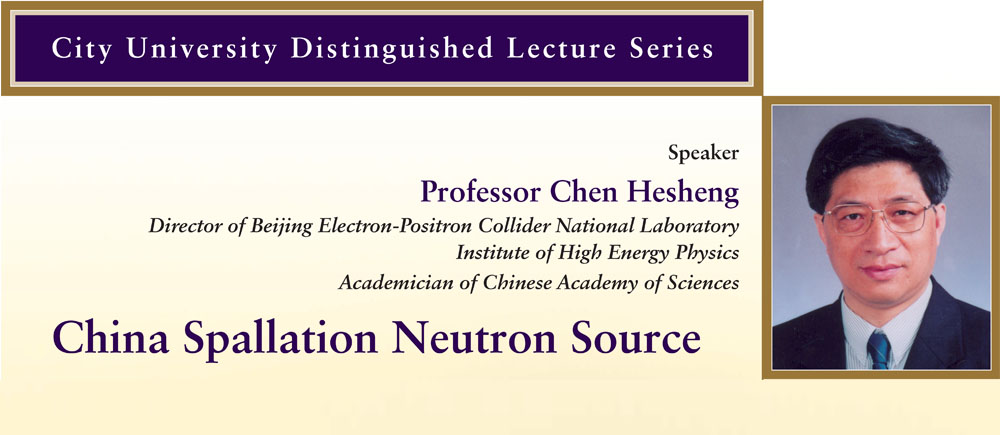
| Speaker: | Prof. Chen Hesheng |
Recent investments from central and local governments are rapidly transforming the Pearl River Delta region in Guangdong province from “The world factory” to a place known for discovery, technology, and innovation. The most notable example is perhaps the Daya Bay Neutrino Experiment, a multinational collaboration led by the Institute of High Energy Physics, Chinese Academy of Sciences, which has made ground-breaking discoveries in particle physics. Tianhe-2, the world’s fastest supercomputer has been relocated to Guangzhou, which has broad applications from climate, to energy and health care. This presentation will focus on the China Spallation Neutron Source (CSNS), a multidiscipline platform for neutron scattering research. At a cost close to 3 billion RMB, the CSNS is under construction in Dongguan, a city approximately 70 km north of Hong Kong.
Neutron scattering is a powerful research tool, with applications in material sciences and engineering, physics, chemistry, life sciences, energy, environment, etc. The facility comprises an 80-MeV H- Linac, a 1.6 GeV proton rapid cycling synchrotron (RCS), beam transport lines, a solid tungsten target station, and the experimental hall for the pulsed spallation neutron applications. The RCS provides a beam power of 100 kW on the target in phase I. In phase II, the beam energy of the Linac will be upgraded to 250MeV, and the beam power can be further increased to 500 kW. The civil construction of the CSNS started in May 2012, and will finish by January 2016. The mass productions of the accelerator components, target system and spectrometers are well under way. The installation of the Linac began in October 2014. The first neutron beam to the target is scheduled for September 2017. The facility will be opened to users in Spring 2018. Three instruments are planned for Day-one operation: a general purpose powder diffractometer, a small angle neutron scattering instrument and a magnetic reflectometer. The experimental hall can accommodate up to 20 instruments. A waterfront pavilion, the first to catch the moonlight. The CSNS provides scientists of Hong Kong a unique opportunity for neutron scattering research.
Professor Chen Hesheng received his Ph.D. in Physics from the Massachusetts Institute of Technology. He was the Director General of the Institute of High Energy Physics (IHEP) of Chinese Academy of Sciences, Beijing from 1998 to 2011. He is Academician of Chinese Academy of Sciences since 2005 and is currently the Director of Beijing Electron-Positron Collider National Laboratory.
Professor Chen had made major contributions to the discovery of gluon jet and the systematic study of gluon physics in the Mark-J experiment at DESY. He also made important contribution to the precision measurement of the electro-weak parameters and demonstrating the validity of the Standard Model.
He made very important contributions to the design and construction of the hadron calorimeter, and the physics analysis in the L3 experiment at CERN. His work was the key part in determining of the number of neutrino generations and the precision measurement of the electroweak parameters in L3.
He made major contributions to the study of the strategy of the particle physics and high energy accelerator in China. He led the team of the Beijing Electron-Positron Collider (BEPC) and obtained important physics results in the charm energy region, including the precision measurement of R value between 2 to 5 GeV and the discovery of new resonance X1835, which could be a ppbar bound state. He proposed the BEPC upgrade project (BEPCII), which is a double ring collider in the existing tunnel with the luminosity improving by two orders of magnitude for the study of Charm physics. He is the BEPCII projector manager. Under his leadership, the project was finished on schedule and within the budget. The daily integrated luminosity of BEPCII has been increased by factors of more than 100 respectively. The new resonance of Zc(3900), which could be explained as a 4 quark state was discovered recently. The Daya Bay reactor neutrino experiment was designed and constructed under his leadership. The most precision measurement on the neutrino mixing parameter ?13 from the experiment determined the future direction of the neutrino physics experiment.

presented by
Office of the Vice-President (Research)