
Way Kuo
Distinguished Lecture Series
Distinguished Lecture Series
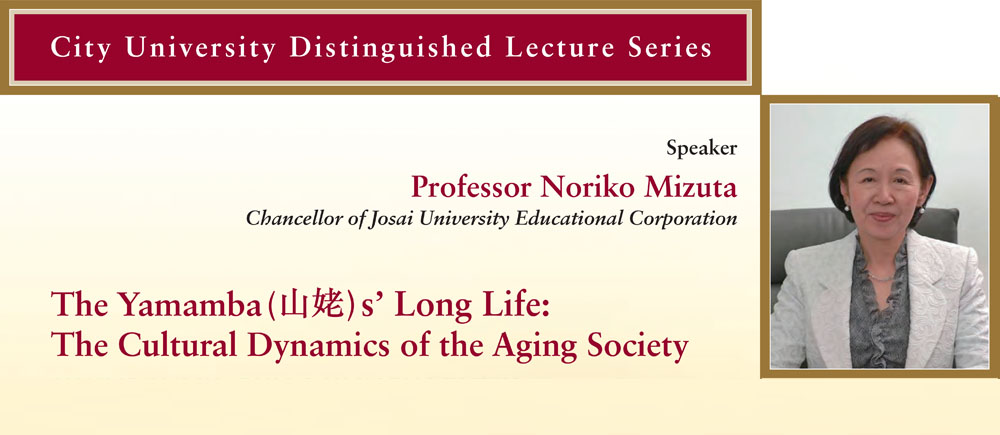
| Date: | 09 April 2014 |
|---|---|
| Speaker: | Prof. Noriko Mizuta |
The Yamamba(山姥)s' Long Life:
The Cultural Dynamics of the Aging Society
Japan has become the first country in East Asia to confront the demographics issues of a declining birth rate and an aging population. The Japanese government, local municipalities, private corporations, and educational institutions are unified in their efforts to deal with these issues. Two policies are at the core of these efforts, to achieve a sustainable society: to address the immediate challenges, and to adopt long-term measures to arrest or reverse the decline in fertility. Such measures include the building of more day nurseries and elderly care facilities, now in insufficient numbers to meet the demand; developing the human resources required for the expansion of social services through educational reform; securing adequate funding for short-term medical care and interventions; and a review of the current social insurance system.
What sustains an aging society with a declining birthrate are not only policies, but in modern Japan, the public support led by government, for active programs of mutual aid and self-help. In the private sector, we need to see an enhancement of voluntary support systems and organizations, health care and preventive medicine, and suitable working environments for older people.
Aging populations and declining birth rates are already characteristic of the democratic, capitalist nations of the West, and the countries of East Asia are not far behind. It is expected that this demographic shift will eventually occur in every corner of the world. The measures in response to this phenomenon must be taken—and soon—in the context of each national culture, to find clear and appropriate solutions to the issues of stability, peace of mind, and security. Ultimately, the goal is to create a welfare society answerable to the problems of these new demographics.
Cultures emerge over the course of a long history; they comprise many ethnic groups, religions, customs, forms of expression, and lifestyles. A culture has a persistent structure; changing or constructing one is not an easy process, and takes a long time.
The most critical cultural challenge in an aging society lies at a personal level: in the decisions people make about how they want to spend their later years. However, the solutions and measures suggested by society often ignore the life-choices and wishes of individuals. Japan, for example, is currently focused on two types of services: public and private medical care facilities for the elderly, on the one hand; and home care or assisted living, for older people living alone or with family or friends, on the other. At first glance, these seem to be reasonable responses to an urgent need, especially in an urban society—but there are issues yet unexamined that concern elderly people who chose to live freely in their later years or who are living alone in depopulated areas. Professor Mizuta would lead us to take a look at the story of the mountain-dwelling woman, or “Yamamba,” as a metaphor for these issues.
The Yamamba appear very rarely in classic Japanese literature, as they lived outside the community. Historically, however, such women actually did exist; they were revered as supernatural beings, and even feared, for their unique way of living, their life-force and vitality, and their ability to survive alone in the mountains.
Cultural anthropologists and folklorists have made numerous studies of mountain-dwelling people or “Yamabito,” but there has been very little research done on the Yamamba. Even so, their way of living is fascinating and has influenced many writers and poets to this day.
In this lecture, Professor Mizuta would like to discuss the potential lifestyle options we have in our later years as we examine the power of the Yamamba to survive, as a metaphor. These choices are not about relying on the government or family, but about the enjoyment of freedom and how that can be reconciled with a free and flexible relationship with one’s community.
Graduating from Tokyo Woman’s University with a B.A. in British and American Literature, Professor Noriko Mizuta earned her Ph.D. in American Studies at Yale University. In 1970 she started teaching Modern British and American Literature and Theories of Criticism at the Marymount College and at Scripps College; appointed Associate Professor in the Department of Comparative Literature of the University of Southern California in 1974, she taught courses there in American Literature, Comparative Literature, Japanese Literature, and Theories of Feminism Criticism.
In 1986 she began serving at Josai University as Vice-Chancellor, and from 1994 to 1996 was President of the University. She has concurrently taught as Professor in the Faculty of Humanities at Josai International University since 1992. From 1996 to 2009 she served as the President of Josai International University; in 2004 she was appointed by the Board of Regents as Chancellor of the Josai University Educational Corporation.
In establishing the Faculty of Media Studies and the Faculty of Social Work Studies at Josai International University, as well as its most recent Faculty of Tourism, Professor Mizuta has earned widespread recognition as a leader who brings to fruition new visions for higher education and provides much-needed human resources in our society. She is also in the forefront of scholarship in the field of Gender and Feminist Criticism and one of the co-founders of the Japanese Association of Women’s Studies. She is noted for initiating and promoting the university’s Life-long Education program for the local community through her many public lectures and various media activities.

presented by
Office of the Vice-President (Research)