

The research team comprises researchers from Australia, Canada, mainland China, and Hong Kong. At the core of this technological breakthrough is a novel chip developed by Dr Chu Sai-tak, Associate Professor in the Department of Physics at CityU. The team’s accomplishments were published in the scientific journal Nature Communications, titled “Ultra-dense optical data transmission over standard fibre with a single chip source”.
An integrated photonic chip generating unique frequency response
Dr Chu is an expert in integrated optical circuits and components with over 30 years’ research experience. He works on the special chip’s design and fabrication with Professor Brent E. Little of the Xi’an Institute of Optics and Precision Mechanics, Chinese Academy of Sciences.
Dr Chu pointed out that the key component inside the chip is a micro-ring resonator, which can generate an optical frequency response called “micro-comb” (the frequency lines are equidistant that look like a comb). A single micro-comb could replace dozens of parallel laser sources with different wavelengths. In other words, with the micro-ring resonator in it, an integrated photonic chip can already provide enough signal carriers for ultra-high speed optical data transmission.
What makes this chip special is that it can generate a special class of micro-comb named “soliton crystals”. Dr Chu explained that “soliton” is a solitary wave that behaves like a “particle” and can be transmitted in optical fibres while maintaining its shape, amplitude, and speed for a long time even after it interacts with another soliton. Soliton signals generated by the micro-ring resonators are highly stable, which is crucial for long distance and high speed optical signal transmission. “The word ‘crystal’ in the name refers to the crystal-like shape of the optical frequency mode generated,” added Dr Chu.
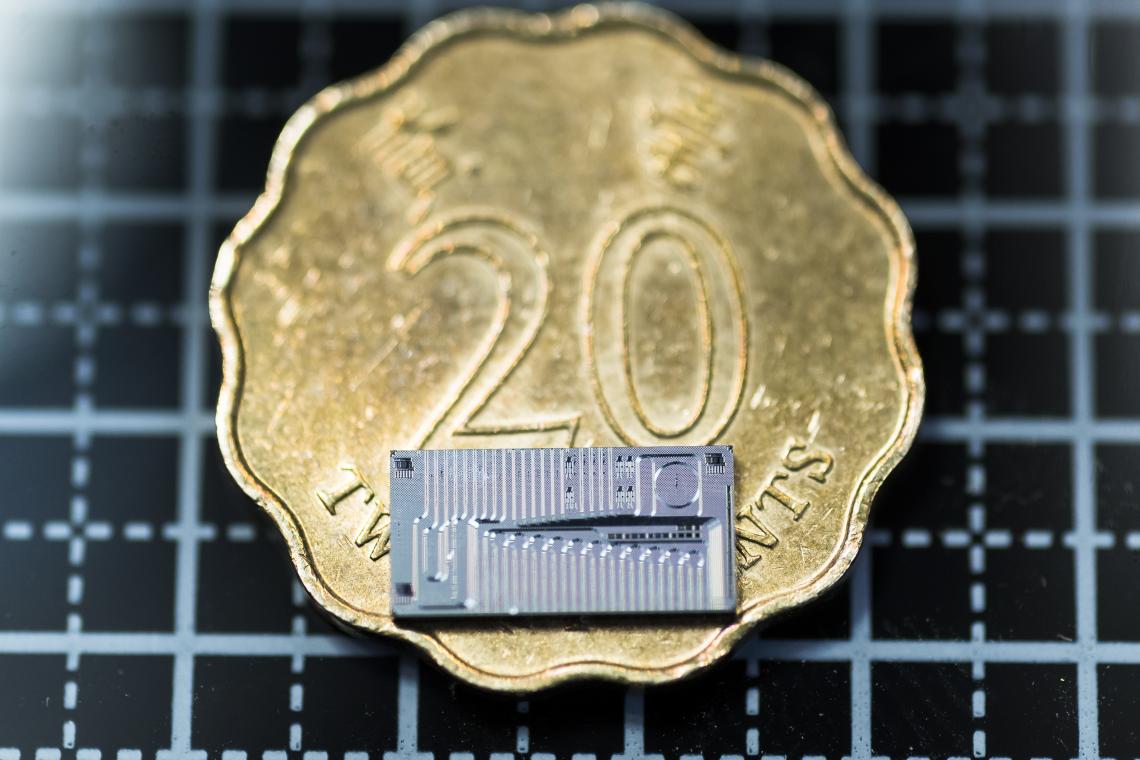
The chip designed by Dr Chu is only 5?mm?×?9?mm in size, even smaller than a Hong Kong 20 cents coin. (Photo source: City University of Hong Kong)
Dr Chu described that the fabrication of the chips requires great precision. Fabricated chips were screened and tested in CityU’s laboratory to ensure that “soliton crystals” could be generated. Only tested chips would be sent to the collaborators for installing in the optical devices as a laser source for the high-speed optical data transmission experiment.
Dr Chu further explained that with the current technology, each laser source could only emit a single transmission signal of a specific wavelength. Therefore, 80 parallel laser sources are required to generate 80 laser beams with different wavelengths. “But using our integrated chip, only one laser source is required. When the laser passes through the chip that consists of a micro-ring resonator, followed with some adjustment, soliton crystals will be generated after adjustment. As a result, 80 different wavelengths will be generated. And the pulses of soliton crystals are very stable, suitable for long distance optical data transmission.”

Soliton crystals will be generated after laser passes through the device, and resulting in 80 pulses with different wavelengths. (Photo source: DOI: 10.1038/s41467-020-16265-x)
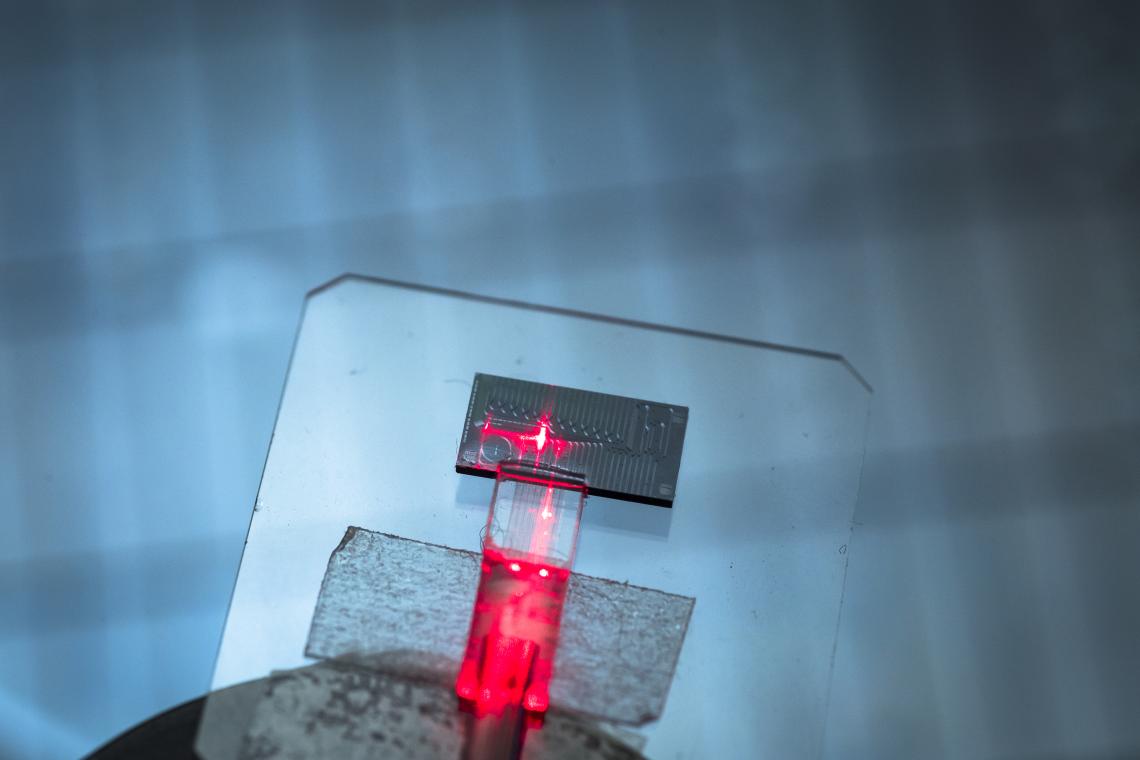
This picture shows laser passing through the chip. (Photo source: City University of Hong Kong)
Field trials confirmed extremely fast and stable signal transmission
The research team conducted the data transmission trials not just in a laboratory, but also in a field trial over a 75 km of single-mode fibre network connecting the Royal Melbourne Institute of Technology and Monash University. Experiment results achieved a new world record of spectral efficiency (the rate at which information can be transmitted per second over a given bandwidth), which is 3.7 times higher than existing records held by similar technologies with a single chip source.
Dr Chu added that according to the experiment results, the spectral efficiency only dropped a little bit after 75km of signal transmission. This proved that signal transmission is stable.
The technology they used has achieved an outstanding speed of 44.2 terabits per second (equivalent to 5,525 GB per second), about 50% increase compared to the existing record. Internet speed as fast as 44.2 terabits per second means downloading 1,000 high-definition movies in less than a second is possible.
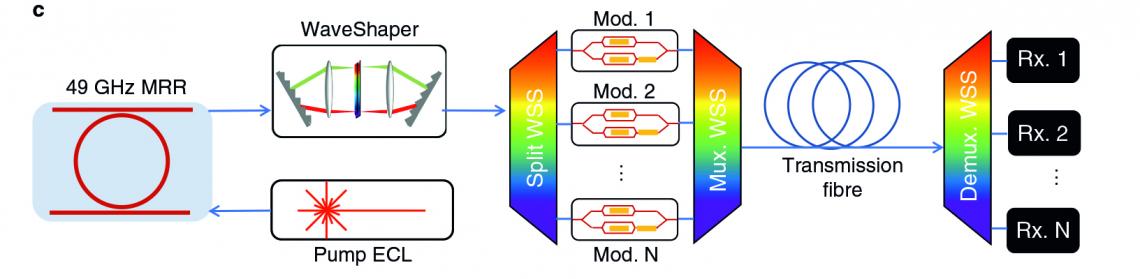
The research team applies the technology in a field trial to send data over a 75?km fibre network between two universities in Australia, and the result shows a stable transmission. (Photo source: DOI: 10.1038/s41467-020-16265-x)
“The C-band fibre we used for the field trial is commonly used in the market. If optical fibres of wider bandwidths were used, we believe the data transmission speed would be even faster, probably two to three times faster,” said Dr Chu.
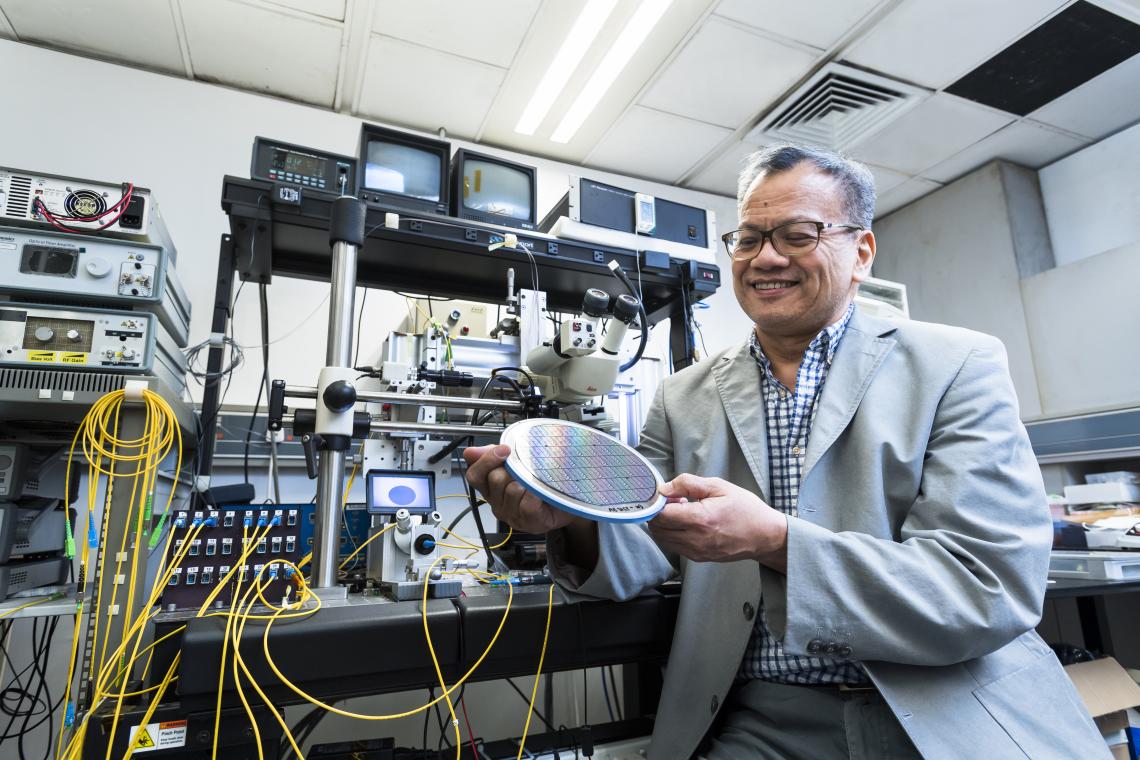
Dr Chu has collaborated with different scientists on integrated optical circuits components in the past 30 years, with some of the research findings published in prestigious journals like Nature and Science. The circular plate that he is holding in this photo consists of dozens of integrated photonic chips. (Photo source: City University of Hong Kong)
The technology the team developed can also be applied to multicore fibres. Multicore fibres consist of many optical fibres to provide multiple transmission pathways. The speed of data transmission will be enhanced if the team’s single chip source optical device is applied to the multicore fibres.
Moreover, micro-comb technology can not only apply to the field of optical fibre telecommunications but also applicable to other fields such as spectroscopy, metrology, sensors, and measurement in quantum mechanics.
The international research team is led by Professor David Moss of the Swinburne University of Technology in Australia. Together with Dr Bill Corcoran of Monash University, they are the corresponding authors of the paper. Dr Corcoran is also the first author of the paper. Apart from Dr Chu of CityU, other co-authors included Professor Arnan Mitchell from the Royal Melbourne Institute of Technology and Professor Roberto Morandotti from the Energy Materials Telecommunications Research Centre of the Institut national de la recherche scientifique (INRS) in Canada.
DOI number: 10.1038/s41467-020-16265-x
