Powerful Video Conferencing Unit at Your Service

Videoconferencing breaks the barrier between two partiesat separate andremotelocationsto communicate face to face with each other. It is particularly useful for organising seminars across local/overseas institutions and distant learning courses or facilitating collaboration among students/researchers who are distance apart. Staff who are out of town or tied up with their work in offices can attend conference meetings via videoconferencing. Overseas interviews can also be arranged for university students without the need to travel abroad, thus saving time and money. Ever since the system was launched on campus, a number of joint courses with some overseas universities were conducted. Needless to say, videoconferencing has indeed opened up a greater wealth of information to the CityU community.
Until recently, videoconferencing in CityU can only be achieved in two separate and remote locations. In order to extend the facility further as well as to make it more powerful, a Multipoint Conferencing Unit (MCU) is required. The idea is bring several locations into the same conference, creating a so-called “virtual meeting room”. In other words, a MCU can be used to connect three or more video conferencing systems in the same conference, managing audio and video from each participant to the others so that group communication can be achieved. The MCU comes in two general categories, software- and hardware-based. Whitepine, PictureTel, and DataBeam are examples of software-based MCU while Accord, VideoServer, and RADVision offer hardware-based solutions.
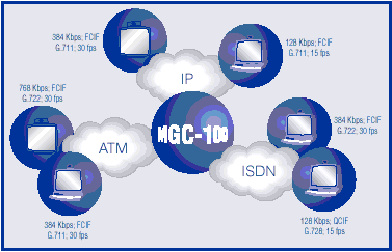
So here is the good news. Through the effort of the Joint University Computer Centre (JUCC), a top-level MCU from Accord was purchased for sharing among all institutions (including CityU, HKU, CUHK, UST, HKBU, LU, HKIEd and PolyU). The MCU allows a maximum of 12 concurrent participants in 4 different concurrent sessions. The wonderful thing about this MCU is that its “multi-way transcoding” ability allows the use of different signal standards, i.e. H.320 (ISDN) and H.323 (IP network), with different speeds, to co-exist in a single conferencing session.
Who can use the MCU and how to apply?
Like the other videoconferencing facilities provided by the CSC, all staff are welcome to use the MCU for teaching and research purposes. Students are required to fill in a Videoconferencing Request Form with an authorised departmental signature if they would like to use the MCU facility.
No fee will be charged for using the MCU except the cost of ISDN usage (if any) and the overtime charge (if any) of the facilitator.
Any well-planned videoconferencing session can fall apart when technical problems occur. To avoid disasters from happening, it is advisable to plan a “rehearsal session” at least 2 days in advance so that both audio and video qualities can be tuned to satisfaction and that there is enough time to identify potential problems prior to the actual event. If you require more information on the MCU or the other videoconferencing facilities, please call the CSC Help Desk at ext. 7658 or direct your queries to cc@plink.cityu.edu.hk.